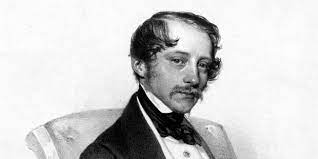
Otto Nicolai – A Complete Biography
Introduction
Carl Otto Ehrenfried Nicolai was one of the most intriguing figures in early Romantic music. Known primarily for his comic opera The Merry Wives of Windsor, he stood at the crossroads between the German and Italian musical worlds of the 19th century. Though his life was brief, Nicolai’s contributions bridged the expressive lyricism of Italian opera with the formal discipline of the German symphonic tradition. His career as a conductor, composer, and founder of the Vienna Philharmonic left an enduring mark on European musical life.

Childhood
Otto Nicolai was born on June 9, 1810, in Königsberg, East Prussia (now Kaliningrad, Russia). His father, Carl Ernst Daniel Nicolai, was a Protestant theologian and music enthusiast who encouraged his son’s musical inclinations from a young age. However, Nicolai’s childhood was far from easy. His parents’ marriage was deeply troubled, and after their separation, the boy suffered both emotional and financial instability.
Despite these hardships, his musical talent became evident early. He received his first instruction in piano and composition as a child, quickly showing precocious skill. His education in Königsberg provided him with exposure to classical repertoire, and his early experience as a church musician instilled in him a sense of structure and reverence that would later characterize his sacred works.
Youth
At the age of sixteen, Nicolai left Königsberg for Berlin, where he continued his musical studies under the guidance of Carl Friedrich Zelter, who had also taught Felix Mendelssohn. Zelter’s influence was significant, emphasizing classical forms, counterpoint, and textual clarity. Nicolai also became acquainted with the music of Johann Sebastian Bach, which profoundly shaped his understanding of compositional technique.
Berlin was a cultural center teeming with artistic energy, and Nicolai’s years there were formative. He worked as an organist and began composing sacred and instrumental works. However, he faced continual financial difficulty and bouts of poor health, both of which would haunt him throughout his life. In these years, he also developed a keen interest in Italian music, an interest that would later lead him to one of the most important chapters of his career.
Adulthood
In 1833, Nicolai’s career took a decisive turn when he was appointed to a position in Italy, first in Rome, then in Trieste, and eventually in Vienna. His years in Italy exposed him to the operatic world of Bellini, Donizetti, and early Verdi. Nicolai absorbed the melodic fluidity of the Italian style but retained his German sense of form and orchestration, a synthesis that would define his later works.
While in Rome, he became organist at the Prussian embassy chapel and soon gained recognition for his performances and sacred compositions. His reputation grew, and he received commissions for operas in Italian, such as Enrico II and Il Templario. The latter, based on Walter Scott’s Ivanhoe, achieved considerable success in Italy and Germany alike.
In 1841, Nicolai returned to Vienna, where he became one of the most respected conductors of his generation. He held important positions at the Kärntnertor Theater and later the Hofoper. His leadership, precision, and taste for refined orchestral color earned him wide admiration. In 1842, he founded the Vienna Philharmonic Orchestra, which remains one of the most prestigious musical institutions in the world.
Major Compositions
Nicolai’s compositional output includes symphonies, overtures, sacred music, and operas, though it is his last opera, Die lustigen Weiber von Windsor (The Merry Wives of Windsor), that secured his place in the canon of 19th-century music.
Completed in 1849, this work is a delightful adaptation of Shakespeare’s comedy. It combines the elegance of Mozart’s Le nozze di Figaro with the wit of Rossini’s Il barbiere di Siviglia. Nicolai’s orchestration is brilliant, his vocal lines graceful, and his sense of humor and dramatic pacing remarkable. The opera became a staple of the German repertoire and is still performed today.
Other notable works include his Symphony in D major, Overture to The Merry Wives of Windsor, Te Deum, and numerous choral pieces. His sacred compositions reflect his early church training and spiritual depth, while his orchestral writing reveals a keen sensitivity to texture and balance.
Nicolai’s music often demonstrates a unique blend of German solidity and Italian lyricism—a reflection of his own cosmopolitan career.
Death
Tragically, Nicolai’s life was cut short at the height of his success. Only two months after the triumphant premiere of The Merry Wives of Windsor in 1849, he suffered a massive stroke and died on May 11 of the same year, in Berlin, at the age of 38. The irony of his untimely death was made even more poignant by the fact that he had just been elected to the prestigious post of Kapellmeister at the Berlin Cathedral.
Nicolai was buried in Berlin, where his colleagues and admirers mourned the loss of a composer who had only begun to realize his full potential.
Conclusion
Otto Nicolai’s career, though brief, occupies a distinctive place in 19th-century European music. As both composer and conductor, he helped bridge two great musical traditions—Germany’s structural rigor and Italy’s lyrical grace. His founding of the Vienna Philharmonic alone would have ensured his legacy, but his operatic masterpiece, The Merry Wives of Windsor, continues to delight audiences with its vitality and charm.
Nicolai’s life story is one of perseverance, artistry, and cultural synthesis. He stands as a symbol of Romantic idealism: a man who pursued beauty and form amid personal struggle and transnational inspiration. Though not as widely known as some of his contemporaries, Otto Nicolai remains a vital figure in the story of European classical music.
Comments are closed