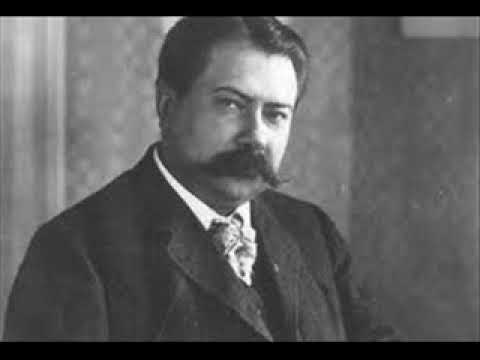
Tor Aulin – A Complete Biography
Introduction
Tor Bernhard Wilhelm Aulin (1866–1914) was a pivotal figure in Swedish musical life at the turn of the 20th century. Though his output as a composer was relatively modest, his influence as a violinist, conductor, and champion of chamber music was profound. He was widely considered the most prominent violinist of his time in Sweden, and his efforts were instrumental in elevating the quality and appreciation of classical music in his home country. Aulin’s career was marked by a dedication to performance and education, often prioritizing the dissemination of great music over his own compositional ambitions. His life, however, was also touched by personal hardship and a premature end, which lends a delicate yet touching strain of melancholy to his most enduring compositions.

Childhood
Tor Aulin was born on September 10, 1866, in Stockholm, Sweden. His family background was one of intellectual and musical cultivation. His father, Lars Axel Alfred Aulin, was a docent of Ancient Greek, but he passed away when Tor was only three years old. This early loss, coupled with what has been described as a “heartlessly strict” mother, contributed to a challenging upbringing. The family’s circumstances required Aulin to become self-sufficient at a remarkably young age. By the time he was 14, he was already required to make his own living, a necessity that forced him into the professional music world early in life. Despite the hardships, his family environment provided a foundation in the arts, as his sister, Laura Valborg Aulin, was also a noted composer and pianist.
Youth
Aulin’s prodigious musical talent quickly became apparent, setting him on a path of rigorous training. He began his formal studies at the Royal College of Music in Stockholm, where he was a student from 1877 to 1883. His primary instructor there was Carl Johan Lindberg. Seeking to further refine his skills, Aulin traveled abroad to the Conservatory of Berlin, where he studied from 1884 to 1886. In Berlin, he received instruction from the renowned violin virtuoso Émile Sauret and the composer Philipp Scharwenka, experiences that shaped his formidable technique and musical sensibilities. The need to earn a living during his youth meant that his first professional engagements involved playing the violin in various theater orchestras, a practical immersion that complemented his academic training.
Adulthood
Aulin’s adult career was one of intense activity and immense contribution to Swedish musical culture. From 1889 to 1892, he served as the concertmaster of the Royal Swedish Opera in Stockholm. However, his true passion lay in chamber music and conducting. In 1887, he founded the Aulin Quartet, which quickly became the first continuously active, full-time professional string quartet in Sweden. The quartet gained an excellent reputation, specializing in both the traditional classical repertoire and the works of Scandinavian composers.
As he entered the 20th century, Aulin devoted more of his time to conducting. He was a driving force behind the formation and leadership of numerous orchestral ensembles, spearheading a revival of interest in the works of Swedish masters like Franz Berwald. His conducting roles included:
•The Swedish Musicians’ Society Orchestra (founded 1900)
•The Stockholm Concert Society (1902–1909), which he helped found
•The Royal Dramatic Theatre Orchestra (1907–1909)
•The Southern Sweden Philharmonic Society (1907–1908)
•The Gothenburg Orchestra Society (1909–1911)
Aulin’s conducting style was noted for being spontaneous and temperamental, yet always serving the music, allowing for the musicians’ own initiatives. He was also a key figure in premiering new works, including several by his close colleague, Wilhelm Stenhammar. His tireless work earned him membership in the Royal Swedish Academy of Music in 1895.
Major Compositions
Tor Aulin did not consider himself a major composer, often viewing his compositional efforts as secondary to his work as a performer and educator. His output is small, yet finely wrought, and is characterized by a lyrical, tuneful quality that places him firmly within the German Romantic tradition, with influences from composers like Robert Schumann and Edvard Grieg. His compositions are conspicuous for their lack of empty flamboyance, prioritizing expressive, musical purpose even in the most technically demanding passages.
His most important works are his three concertante pieces for violin and orchestra:
•Violin Concerto No. 1 in G minor (1889, published as Concert Piece): An extended single movement work, lyrical in nature, with connected sections in slow and moderate tempos.
•Violin Concerto No. 2 in A minor (1892): This concerto features a richer use of orchestral color and a wider emotional range, with Aulin frequently shifting between major and minor modes to create a distinctive, melancholic flavor.
•Violin Concerto No. 3 in C minor, Op. 14 (1896): Considered his masterpiece and a genuine gem of the Swedish repertoire, this work is noted for its absorbing structure and subtly Nordic harmonic coloring. It is often seen as a stepping stone between the concertos of Max Bruch and Jean Sibelius.
Other notable works include:
| Category | Work Title(s) | Opus Number | Notes |
| Chamber Music | Violin Sonata in D minor | Op. 12 | Premiered in 1892. |
| Orchestral Suite | Mäster Olof Suite | Op. 22 | Incidental music for August Strindberg’s play. |
| Miniatures | Fyra akvareller (Four Watercolors) | Op. 15 | Popular pieces for violin and piano. |
| Dances | Gotländska danser (Gotlandic Dances) | Op. 28 | Two dance suites, alongside Svenska danser (Op. 32). |
Death
Aulin’s demanding career and early hardships took a toll on his health. In his forties, he began to suffer from health problems that made both playing the violin and conducting increasingly difficult and painful. These ailments ultimately proved fatal. Tor Aulin died prematurely at the age of 47 on March 1, 1914, in the coastal resort of Saltsjöbaden, near Stockholm. His death silenced one of Sweden’s most influential musical voices, bringing an end to a career that had spanned two decades of tireless work as a performer, conductor, and cultural educator.
Conclusion
Tor Aulin’s legacy rests not only on his compositions, particularly the third Violin Concerto, but perhaps even more significantly on his role as a public music educator and cultural catalyst. He was a musician whose priorities lay more with the performance and dissemination of great music than with the pursuit of personal fame as a composer. Through the Aulin Quartet and his various orchestral directorships, he set new standards for musical excellence and helped to shape the modern orchestral landscape in Sweden. His life, marked by dedication and shadowed by melancholy, is a testament to a musician who viewed himself as an instrument for the music of others, leaving behind a body of work that continues to resonate with a quiet, expressive beauty.
Comments are closed