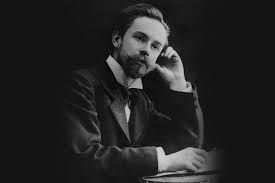
Alexander Scriabin – A Complete Biography
Introduction
Alexander Scriabin stands as one of the most innovative and enigmatic figures in Western classical music. A Russian composer and pianist active during the late Romantic and early Modern eras, he transformed musical language with daring harmonic experiments and a philosophy that blended mysticism, color symbolism, and metaphysical ambition. Scriabin’s impact on early twentieth-century music remains profound; his daring exploration of harmony foreshadowed later developments in atonality, while his philosophical vision set him apart as one of music history’s most distinctive voices.
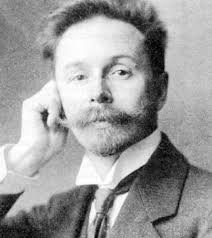
Childhood
Alexander Nikolayevich Scriabin was born on January 6, 1872, in Moscow, into an aristocratic family with strong academic and military ties. His father, a diplomat, left for Turkey soon after Alexander’s birth. His mother, a talented pianist, died when he was just one year old. Consequently, Scriabin was raised primarily by female relatives, notably his aunt Lyubov, who cultivated his early interest in music.
A physically frail child, Scriabin developed inward tendencies and an intense imagination. He often constructed elaborate fantasies and mechanical toys, some resembling miniature stage sets—an early hint of his later fascination with grand artistic visions. His first exposure to the piano came through his aunt’s instruction, and observers quickly noticed his extraordinary sensitivity to sound and melody. The family’s cultural environment, which included poetry, literature, and music, helped shape his early artistic sentiments.
Youth
Scriabin’s formal musical training began in earnest when he enrolled in the Moscow Conservatory. There, he studied piano with the legendary teacher Vasily Safonov and composition with Anton Arensky and Sergei Taneyev. Although he excelled as a pianist, he grew increasingly dissatisfied with academic rigidity, particularly in composition classes.
While at the Conservatory, Scriabin became fascinated with the works of Chopin. This influence permeated his early compositions—especially his preludes, études, and mazurkas—which display delicate lyricism and refined pianistic textures. His obsession with technique, however, had consequences. He practiced obsessively, eventually injuring his right hand through overexertion. This setback became a pivotal moment, inspiring him to channel more energy into composition. The injury also fueled his developing belief that physical limitations could be transcended through spiritual and artistic passion.
Scriabin graduated in 1892 as one of the Conservatory’s notable talents. Although his compositional technique had yet to mature, his distinctive voice was already taking shape.
Adulthood
Scriabin’s adult life was marked by creativity, travel, personal upheaval, and radical shifts in philosophy. Early in his career, he supported himself primarily as a pianist, giving recitals across Europe and promoting his own works. These tours broadened his horizons, exposing him to new ideas in literature, art, and the burgeoning symbolist movement.
In 1897, he married pianist Vera Ivanovna Isakovich. The couple had four children, but Scriabin’s restless temperament strained the marriage. By the early 1900s, he had begun a relationship with Tatiana Fyodorovna Schloezer, who became his devoted companion and supporter; they eventually had children as well.
During this period, Scriabin became deeply involved with mystical philosophy, particularly Theosophy. He developed a personal worldview in which art, especially music, served as a vehicle for spiritual transcendence. He believed that human consciousness could be elevated through the fusion of sound, color, and mystical experience. These ideas profoundly influenced his later musical aesthetic.
By 1904, Scriabin had left Russia for extended stays in Switzerland, Italy, and Belgium, where he composed some of his most groundbreaking works. His music increasingly embraced bold harmonic structures, dissolving traditional tonality and establishing his reputation as an avant-garde visionary. His writings reveal that he imagined an ultimate work—Mysterium—a vast, multisensory performance intended to trigger the transformation of the world into a higher plane of existence.
Major Compositions
Scriabin’s compositional journey divides naturally into three stylistic periods: early Romantic, transitional, and late mystical.
Early Romantic Period
His early works show strong ties to Chopin, featuring poetic piano miniatures, lyrical lines, and traditional tonal harmony. Notable compositions include:
- Preludes, Op. 11
- Études, Op. 8
- Piano Concerto in F-sharp minor, Op. 20
These pieces reveal refined craftsmanship and emotional delicacy, but still operate within late Romantic norms.
Transitional Period
Around the turn of the century, Scriabin began expanding harmonic structures and exploring symbolic meanings in music. Works from this time include:
- Symphony No. 3, “The Divine Poem,” Op. 43
- Symphony No. 4, “The Poem of Ecstasy,” Op. 54
- Piano Sonata No. 4, Op. 30
Here, Scriabin’s orchestral imagination flourished, blending lush colors with increasingly dissonant harmonies.
Mystical or Late Period
Scriabin’s final creative phase is the most revolutionary. He abandoned traditional tonality in favor of synthetic chords—particularly the so-called “mystic chord.” His works became expressions of spiritual transformation, synesthesia, and metaphysical ambition.
Major pieces from this period include:
- Piano Sonata No. 5, Op. 53
- Piano Sonatas Nos. 6–10
- Prometheus: The Poem of Fire, Op. 60
Prometheus features a part for a “color organ,” intended to project lights corresponding to the music’s harmonic progressions—a bold attempt to merge sound and color in a unified sensory experience.
Scriabin spent his final years envisioning Mysterium, a massive ritualistic performance integrating music, light, scent, movement, and architecture. Although he left sketches, the project was never realized.
Death
Alexander Scriabin’s life ended abruptly on April 27, 1915, in Moscow, at the age of forty-three. He died from septicemia caused by an untreated infection from a boil on his lip—a tragically mundane cause for a man who dreamed of cosmic transformation.
His death shocked the Russian artistic community. Many contemporaries believed that he was on the verge of achieving a new, unparalleled artistic vision. Despite the incompleteness of Mysterium, his influence on later Russian modernists, including Messiaen, Roslavets, and the early avant-garde, was profound.
Conclusion
Alexander Scriabin remains one of the most original and visionary composers in classical music history. From Chopinesque beginnings to the metaphysical sound world of his late works, he followed a path driven not only by artistic ambition but by a quest for spiritual enlightenment. His bold harmonic language anticipated later developments in modern music, while his philosophical aspirations set him apart from any composer of his time.
Though his life was brief, Scriabin challenged the boundaries of what music could be—sound, color, symbol, ritual, and transcendence. His legacy endures as a testament to the power of imagination and the unending human search for deeper meaning through art.
Comments are closed