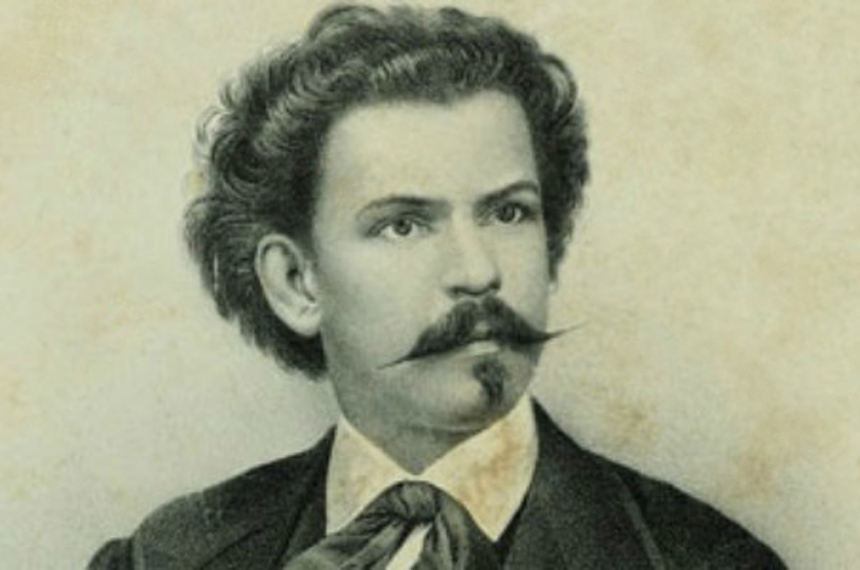
Antônio Carlos Gomes – A Complete Biography
Introduction
Antônio Carlos Gomes (1836–1896) was one of the most celebrated Brazilian classical composers of the nineteenth century and the first from the Americas to achieve major international acclaim in the world of Italian opera. His music blended the dramatic traditions of European Romanticism with elements of Brazilian culture, resulting in a unique and expressive voice. Gomes’s operas once dominated stages in Italy, were admired by composers such as Verdi, and continue to represent a milestone in the development of Brazilian art music.

Childhood
Antônio Carlos Gomes was born on July 11, 1836, in Campinas, in the province of São Paulo, Brazil. He grew up in a musically rich environment. His father, Manuel José Gomes—known as “Maneco Músico”—was a respected bandmaster and multi-instrumentalist. From a young age, Antônio was surrounded by rehearsals, instruments, and the rhythm of everyday musical practice.
Like many children raised in musical families, he showed early talent. By the age of ten, he was already participating in local music groups, and his father took charge of his first lessons in harmony, counterpoint, and composition. His upbringing in Campinas exposed him to both European musical traditions and the local folk and Afro-Brazilian influences that would later appear in his works.
Youth
In his late teens, Gomes composed his first pieces for regional events and religious ceremonies, gaining a reputation as a promising young musician. Seeking professional training, he moved to Rio de Janeiro in 1859, where he enrolled at the Imperial Conservatory of Music.
Under the guidance of esteemed professors, he developed technical maturity and began composing large-scale works. His first opera, A Noite do Castelo (1861), was premiered in Rio de Janeiro and widely praised. This success was followed by Joana de Flandres (1863), which further solidified his national reputation.
The acclaim he received caught the attention of Emperor Dom Pedro II, an active patron of the arts. Impressed by Gomes’s talent, the Emperor awarded him a scholarship to study in Italy—the epicenter of nineteenth-century operatic culture.
Adulthood
Gomes arrived in Milan in 1864 to immerse himself in the rigorous musical life of the Milan Conservatory. There, he refined his compositional technique and absorbed the style of Italian opera. Milan’s artistic environment was competitive and demanding, but Gomes quickly adapted, demonstrating fluency in dramatic writing and a natural sense for vocal lyricism.
His breakthrough came with the opera Il Guarany (1870), based on the Brazilian novel O Guarani by José de Alencar. Premiered at La Scala, the work was an instant triumph. Critics hailed it as fresh, powerful, and brilliantly orchestrated. The opera’s success made Gomes the first non-European to achieve such acclaim in Italy.
He remained in Europe for most of his career, producing several operas, participating in cultural circles, and maintaining correspondence with prestigious composers and conductors. Despite professional success abroad, his later years brought financial difficulties. Still, he continued composing and accepted posts as a cultural representative, including a directorship position for music education in the Brazilian state of Pará.
Major Compositions
Antônio Carlos Gomes’s catalog includes operas, sacred works, chamber music, and orchestral compositions. His main achievements lie in opera, where he combined Italian Romantic aesthetics with Brazilian themes and colors.
Major Operas
- A Noite do Castelo (1861)
Gomes’s first opera, written during his time in Rio de Janeiro, displaying early signs of his dramatic instincts. - Joana de Flandres (1863)
Premiered at the Imperial Theater in Rio; praised for its maturity and orchestration. - Il Guarany (1870)
His masterpiece and greatest international success. The aria “Sento una forza indomita” and the overture remain staples of concert repertoire. - Fosca (1873)
Noted for its intense drama and advanced harmonic language, showing the influence of mature Italian opera. - Salvador Rosa (1874)
A work that reinforced his reputation in Italy and broadened his stylistic palette. - Lo Schiavo (1889)
A highly significant opera that explores themes of slavery and liberation. Though composed in Italian style, it incorporates unmistakably Brazilian elements. It is widely regarded as one of his finest achievements. - Condor (1891)
One of his late operas, distinguished by dramatic depth and refined orchestration.
Other Works
Gomes also wrote:
- Choral works
- Symphonic poems
- Art songs
- Sacred compositions
Although overshadowed by his operas, these works demonstrate his versatility and command of various musical forms.
Death
Antônio Carlos Gomes spent his final years in Belém, Pará, having accepted a position to lead the local music conservatory. Despite health issues and persistent financial strain, he remained committed to promoting musical education in northern Brazil.
He died on September 16, 1896, at the age of 60. His body was later transferred to his hometown of Campinas, where he is honored in a mausoleum dedicated to his legacy. Over time, his reputation has grown considerably in Brazil, and he is celebrated as one of the country’s most important cultural figures.
Conclusion
Antônio Carlos Gomes occupies a crucial place in the history of classical music. He achieved something extraordinary for a Brazilian composer of the nineteenth century: recognition at the highest levels of European operatic culture. His works, particularly Il Guarany and Lo Schiavo, blend the expressiveness of Italian Romantic opera with the spirit, colors, and identity of Brazil.
Although the international operatic landscape changed dramatically after his lifetime, Gomes’s influence endures. His music continues to be performed, studied, and rediscovered, affirming his status as a pioneer who opened the doors of European opera houses to Latin American composers. Through his unique voice and artistic determination, Antônio Carlos Gomes remains a symbol of Brazil’s musical heritage and its deep cultural connections to the wider world.
Comments are closed