César Franck – A Complete Biography
Introduction
César-Auguste-Jean-Guillaume-Hubert Franck stands as one of the most influential figures in late nineteenth-century French music. Though born in present-day Belgium, Franck spent the greater part of his life in Paris, where he established himself as a revered organist, composer, and pedagogue. His music—characterized by rich chromatic harmony, profound spiritual depth, and the systematic use of cyclic form—played a decisive role in shaping modern French symphonic and chamber traditions. While recognition during his lifetime was modest, Franck’s posthumous reputation grew steadily, and he is now regarded as a foundational bridge between German Romanticism and the emerging French musical renaissance of the fin de siècle.
Childhood
César Franck was born on December 10, 1822, in Liège, a culturally active city that at the time belonged to the United Kingdom of the Netherlands. His father, Nicolas-Joseph Franck, recognized his son’s musical abilities at an early age and became the principal force behind his formal training. Franck began piano lessons as a child and soon demonstrated exceptional aptitude, particularly in sight-reading and improvisation.
He enrolled at the Royal Conservatory of Liège, where he studied piano, organ, harmony, and counterpoint. His instructors quickly acknowledged his disciplined technique and intellectual grasp of musical structure. Even during these early years, Franck showed an affinity for contrapuntal writing and expressive harmonic language—traits that would later define his mature style. His childhood education was rigorous, systematic, and goal-oriented, reflecting his father’s ambition to mold him into a professional concert musician.
Youth
In 1835, the Franck family relocated to Paris in pursuit of broader artistic opportunities. César continued his studies privately before entering the Conservatoire de Paris, where he worked under prominent teachers including Anton Reicha. At the Conservatoire, Franck excelled academically, earning prizes in piano and composition, though his status as a foreign-born student limited his eligibility for certain institutional honors.
During his youth, Franck was presented publicly as a piano virtuoso, performing both solo repertoire and original works. However, these concert ventures met with limited success, and the pressure exerted by his father increasingly conflicted with his own artistic inclinations. By the early 1840s, Franck began distancing himself from the career of a touring pianist, gravitating instead toward composition, improvisation, and sacred music.
This transitional period was marked by personal independence and artistic self-reflection. Franck married Félicité Saillot in 1848, an event that coincided with his definitive withdrawal from his father’s control. He thereafter embraced a quieter professional life centered on church music and teaching.
Adulthood
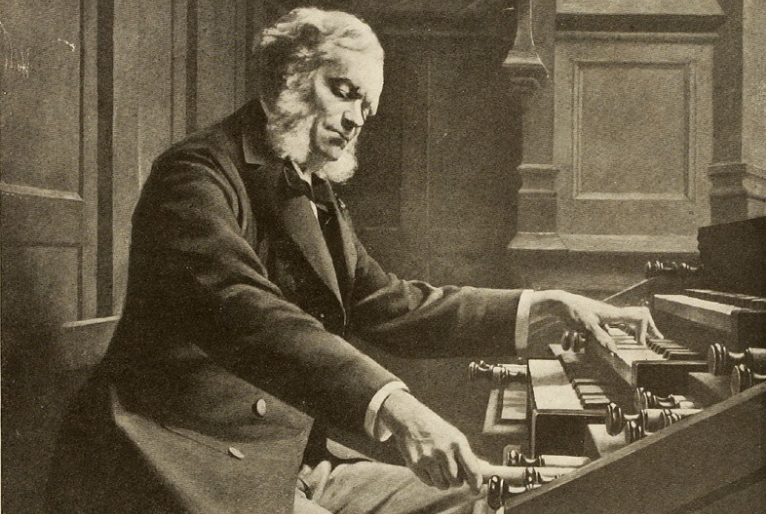
Franck’s adult life was defined by extraordinary consistency and devotion to music. After serving as organist at several Parisian churches, he was appointed titular organist at the Basilica of Sainte-Clotilde in 1858. This position proved decisive. The basilica housed a new Cavaillé-Coll organ, whose symphonic capabilities profoundly influenced Franck’s approach to organ composition and improvisation.
Franck became widely admired as an improviser, capable of constructing large-scale musical forms spontaneously during liturgical services. His reputation as a musician of deep spirituality and humility grew steadily, earning him respect even among critics who were initially skeptical of his compositional style.
In 1872, Franck was appointed professor of organ at the Conservatoire de Paris. Although he taught organ performance, his instruction extended far beyond technical matters, emphasizing harmonic exploration, formal coherence, and expressive integrity. His students—among them Vincent d’Indy, Ernest Chausson, Henri Duparc, and Charles Tournemire—formed a loyal circle that later became known as the “Franckist” school. Through them, his influence extended well into the twentieth century.
Major Compositions
Franck’s mature compositional output emerged relatively late, with most of his most significant works written after the age of fifty. His music is distinguished by the use of cyclic form, in which thematic material recurs across multiple movements to create structural unity.
Among his most important works are:
- Symphony in D minor (1888), his only symphony, which blends Germanic formal rigor with French lyricism and orchestral color. Initially controversial, it later became a staple of the symphonic repertoire.
- Violin Sonata in A major (1886), written as a wedding gift for violinist Eugène Ysaÿe, now regarded as one of the greatest violin sonatas ever composed.
- Piano Quintet in F minor (1879), a powerful and emotionally intense chamber work that marked a turning point in his compositional maturity.
- Symphonic poems, including Les Éolides and Le Chasseur maudit, which reveal his engagement with programmatic orchestral writing.
- Sacred and choral works, notably Les Béatitudes, a monumental spiritual composition reflecting his lifelong Catholic faith.
- Organ works, culminating in the Trois Chorals of 1890, which are considered summative statements of Romantic organ literature.
Franck’s harmonic language, influenced by Beethoven, Bach, and Wagner, was often advanced for French audiences of his time, yet it laid the groundwork for later composers such as Debussy and Dukas.
Death
In July 1890, Franck was injured in a street accident in Paris when a horse-drawn cab collided with a tram. Although he initially appeared to recover, his health gradually deteriorated. Despite his declining condition, he continued to compose and completed the Trois Chorals during the final months of his life.
César Franck died on November 8, 1890, at the age of sixty-seven. His funeral was attended by numerous students, colleagues, and admirers, reflecting the deep respect he commanded within the musical community. In the years following his death, performances of his works increased significantly, solidifying his legacy.
Conclusion
César Franck’s importance in music history rests not on prolific output, but on depth, integrity, and influence. As a composer, he enriched French music with structural discipline, harmonic boldness, and spiritual seriousness. As a teacher, he shaped an entire generation of composers who carried his ideals into the twentieth century. Today, Franck is recognized as a central architect of modern French musical thought, a master whose work continues to resonate in concert halls, churches, and conservatories worldwide.
Comments are closed