
Introduction
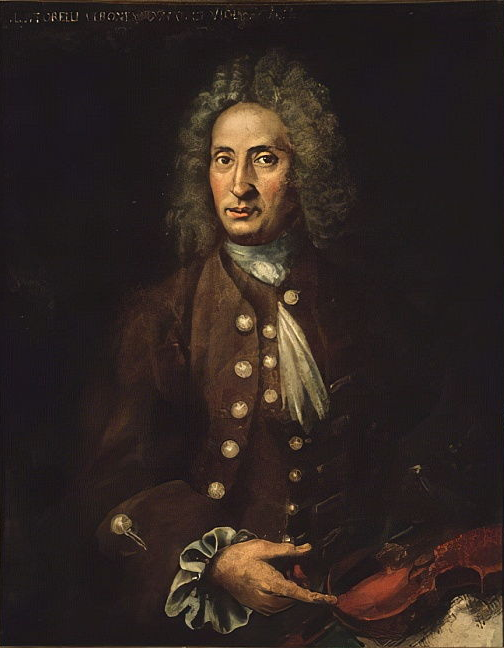
Giuseppe Torelli stands among the most influential composers of the Baroque era. Although he is not as widely recognized today as some of his contemporaries, his contributions to instrumental music helped shape the development of the concerto, particularly the solo concerto and the concerto grosso. A gifted violinist, violist, teacher, and composer, Torelli played a crucial role in establishing musical forms that would later be perfected by composers such as Antonio Vivaldi and Johann Sebastian Bach. His innovative writing for strings and trumpets left a lasting mark on European music and secured his place among the pioneers of the Baroque concerto.
Childhood
Giuseppe Torelli was born on April 22, 1658, in Verona, then part of the Republic of Venice. Little documentation survives concerning his earliest years, but it is known that he displayed musical talent from a young age. His family encouraged artistic pursuits; his brother, Felice Torelli, would later become a respected painter in Bologna.
Although historians are uncertain about the identity of his first violin teacher, it is believed that Torelli received a solid musical education in Verona. During his childhood, Italy was experiencing a flourishing of instrumental music, and the young musician grew up surrounded by the rich traditions of church and court music. These influences helped shape his future artistic direction and inspired his lifelong interest in string instruments.
Youth
As a young man, Torelli moved to Bologna, one of the most important musical centers in Europe. There he studied composition with the distinguished composer Giacomo Antonio Perti. Under Perti’s guidance, Torelli refined his compositional technique and gained access to Bologna’s vibrant musical community.
A significant milestone occurred in 1684 when he was admitted to the prestigious Accademia Filarmonica di Bologna as a violinist. Membership in this elite institution was a mark of exceptional musical ability and greatly enhanced his professional reputation.
Two years later, he joined the orchestra of the Basilica di San Petronio as a violist. The basilica maintained one of the finest musical establishments in Italy and became the primary environment in which Torelli developed his compositional style. During these years, he published his first collections of sonatas and chamber concertos, quickly gaining recognition throughout northern Italy.
Adulthood
The most productive period of Torelli’s career unfolded during the late seventeenth century. Working in Bologna, he became a leading figure of the Bolognese school of instrumental music. His compositions demonstrated a growing interest in contrasting soloists with larger ensembles, a concept that would become central to the concerto form.
Around 1696, financial difficulties led to the dissolution of the orchestra at San Petronio. Torelli subsequently sought opportunities elsewhere and traveled to German-speaking territories. By 1698, he had become maestro di concerto at the court of Georg Friedrich II in Ansbach. There he collaborated with the celebrated singer and composer Francesco Antonio Pistocchi and directed important musical performances.
During his years abroad, Torelli also spent time in Vienna, where he encountered diverse musical influences and expanded his professional network. Nevertheless, he eventually returned to Bologna in 1701, resuming his position at San Petronio under the direction of his former teacher, Perti.
Despite occasional health problems, Torelli remained active as a performer, teacher, and composer. Among his students was Francesco Manfredini, who would later become a respected composer in his own right. Torelli’s reputation spread across Europe, and his music was frequently performed in Italy, Germany, and Austria.
Major Compositions
Giuseppe Torelli’s greatest achievement was his contribution to the evolution of the concerto. He helped establish many of the structural principles that became standard in the Baroque concerto, including the use of contrasting solo and orchestral passages and the adoption of a three-movement fast-slow-fast design.
Among his most important publications are:
Opus 1 (1686) – Sonate a 3
A collection of trio sonatas demonstrating his mastery of chamber music and contrapuntal writing.
Opus 2 (1686) – Concerti da Camera
Twelve chamber concertos that reveal his early experimentation with instrumental contrast and dialogue.
Opus 3 (1687) – Sinfonie
These works contributed to the growing popularity of purely instrumental music during the Baroque period.
Opus 4 (1688) – Concertino per Camera
A set of compositions that further explored the relationship between solo instruments and accompaniment.
Opus 5 (1692) – Sinfonie a 3 e Concerti a 4
An important collection illustrating the transition toward the mature concerto style.
Opus 6 (1698) – Concerti Musicali a Quattro
These concertos demonstrate Torelli’s increasing sophistication in orchestral writing and formal design.
Opus 8 (1709) – Concerti Grossi con una Pastorale per il Santissimo Natale
Published around the time of his death, this collection is considered one of his finest achievements. It contains both concerto grosso and solo concerto elements and includes the celebrated Christmas Pastorale. Many scholars regard this set as one of the landmarks of early concerto literature.
Torelli also became renowned for his trumpet music. He composed more trumpet concertos than any other major Italian composer of his era, helping establish the trumpet as a prominent solo instrument in Baroque orchestral music. His trumpet concertos remain among the most frequently performed works in the Baroque trumpet repertoire.
Death
Giuseppe Torelli spent his final years in Bologna. Although he continued to enjoy professional respect, his health gradually declined. On February 8, 1709, he died in Bologna at the age of fifty.
His death marked the end of a career that had significantly influenced the development of instrumental music. He was buried in Bologna, where many of his manuscripts were preserved in the archives of San Petronio. These manuscripts have provided valuable insight into his creative process and have helped modern scholars assess his importance in music history.
Conclusion
Giuseppe Torelli occupies a central position in the history of Baroque music. As a virtuoso violinist, respected teacher, and innovative composer, he helped transform the concerto from an emerging idea into one of the defining musical forms of the eighteenth century. His experiments with orchestral contrast, solo virtuosity, and formal structure laid the groundwork for later masters such as Vivaldi and Bach.
Although his name is sometimes overshadowed by those who followed him, Torelli’s influence remains undeniable. His concertos, sonatas, and trumpet works represent a vital link between the early Baroque traditions and the mature concerto style that would dominate European instrumental music for generations. Today, he is remembered as one of the true pioneers of the concerto and a key architect of the Baroque instrumental tradition.
Comments are closed