Introduction
Classical music represents one of the most significant and enduring achievements in the history of human civilization. Across centuries, it has evolved through profound transformations in musical language, compositional techniques, instrumentation, performance practices, and aesthetic philosophy. From the sacred chants of medieval monasteries to the monumental symphonies of the Romantic period, and from the experimental compositions of the twentieth century to the diverse musical expressions of the present day, classical music reflects the intellectual, cultural, spiritual, and artistic development of Western society.
Although the expression classical music is frequently used to describe the entire tradition of Western art music, it also refers more specifically to the Classical period of the eighteenth and early nineteenth centuries. In its broader meaning, however, the term encompasses a historical tradition extending over more than a thousand years, characterized by the written preservation of musical works, the development of sophisticated compositional systems, and the continuous exploration of musical expression.
The history of classical music cannot be understood independently of the societies in which it developed. Religion, politics, philosophy, literature, scientific discoveries, technological innovations, and changing conceptions of artistic individuality all played important roles in shaping its evolution. Each historical period introduced new musical possibilities while preserving, transforming, or reacting against the traditions that preceded it.
This historical journey examines the principal periods of classical music, their defining characteristics, their most influential composers, and the artistic innovations that established the foundations of the musical tradition we know today.
1. Ancient Music: The Foundations of Western Musical Thought
The origins of Western musical culture can be traced to the civilizations of ancient Greece and Rome, although musical practices existed in human societies long before written historical records.
Ancient Greek civilization made particularly important contributions to the theoretical and philosophical understanding of music. Music was not regarded merely as entertainment but as an essential component of education, religion, mathematics, and intellectual life.
Greek philosophers explored the relationship between musical intervals and mathematical proportions. Pythagoras, traditionally associated with the discovery of numerical relationships governing consonant intervals, contributed to a conception of music as an expression of mathematical order. This understanding influenced subsequent European theories of harmony and musical organization.
Plato and Aristotle also considered the influence of music on human character and society. Plato, in particular, believed that musical education could shape moral development and that different musical modes possessed distinct psychological and ethical qualities.
Ancient Greek musical theory included concepts such as modes, scales, rhythmic structures, and melodic organization. Although the precise sound of much ancient music remains difficult to reconstruct, surviving theoretical writings and archaeological evidence demonstrate the sophistication of its musical culture.
The Romans inherited many Greek musical concepts and incorporated music extensively into religious ceremonies, theatrical performances, military activities, and public entertainment. However, the transmission of Greek musical theory through Roman and later medieval intellectual traditions proved more historically influential than the preservation of particular Roman musical practices.
Although ancient music differs considerably from what is now understood as classical music, its theoretical foundations helped establish the intellectual framework upon which later European musical traditions developed.
2. The Medieval Period (Approximately 500–1400)
The Medieval period represents the earliest major stage in the documented history of Western classical music. During these centuries, Christianity became the principal institutional force shaping musical development in Western Europe.
Music played an essential role in religious worship, particularly within monasteries, churches, and cathedrals. The most characteristic musical form of this period was Gregorian chant, a tradition of monophonic sacred singing associated with the Roman Catholic liturgy.
Gregorian chant consists of a single melodic line performed without instrumental accompaniment. Its melodies generally move freely according to the rhythm and structure of the Latin liturgical texts. Rather than emphasizing dramatic contrast or harmonic progression, chant seeks to create an atmosphere of contemplation, spiritual concentration, and devotion.
The development of musical notation was one of the most important achievements of the medieval period. Initially, singers relied primarily on oral transmission and memory. Early neumatic notation provided visual indications of melodic movement, although it did not initially specify exact pitches or rhythms.
During the eleventh century, the Italian monk Guido of Arezzo made significant contributions to the development of musical education and notation. His teaching methods, including the use of a system of lines to identify pitches, helped make musical instruction more systematic and facilitated the preservation and transmission of musical repertoire.
Another fundamental development was the emergence of polyphony, the simultaneous combination of two or more independent melodic lines. While early Christian chant was predominantly monophonic, composers gradually began introducing additional voices to existing melodies.
By the twelfth and thirteenth centuries, important centers of polyphonic composition had emerged, particularly around Notre-Dame Cathedral in Paris. Composers associated with the Notre-Dame school, including Léonin and Pérotin, contributed to the development of increasingly elaborate polyphonic structures.
The thirteenth and fourteenth centuries witnessed further experimentation with rhythm, notation, and compositional complexity. The musical style known as Ars Nova, particularly associated with fourteenth-century France, introduced more sophisticated rhythmic notation and expanded the possibilities of secular and sacred composition.
Among the important composers of the later medieval period was Guillaume de Machaut, whose works demonstrate considerable refinement in both sacred and secular music.
The medieval period established essential foundations for Western classical music: written notation, organized musical education, polyphonic composition, and the institutional preservation of musical works.
3. The Renaissance Period (Approximately 1400–1600)
The Renaissance was characterized by a renewed interest in classical antiquity, humanism, intellectual inquiry, and artistic refinement. These cultural transformations profoundly influenced musical composition.
Unlike the predominantly religious musical environment of the earlier medieval centuries, Renaissance music developed across both sacred and secular contexts. Courts, aristocratic households, urban centers, churches, and emerging printing establishments became important centers of musical activity.
One of the defining characteristics of Renaissance music was the development of increasingly sophisticated polyphony. Composers explored the interaction of independent melodic lines, creating intricate musical textures in which each voice contributed to the overall structure.
Imitative counterpoint became particularly important. In this technique, a melodic idea introduced by one voice is subsequently repeated or developed by other voices, producing a unified musical composition through the interaction of independent parts.
Sacred music continued to occupy a central position, especially through the development of the Mass and the motet. However, secular forms also flourished, including the madrigal, chanson, and various instrumental dances.
The invention of movable-type music printing in the early sixteenth century, particularly through the work of Ottaviano Petrucci, transformed the dissemination of musical compositions. Printed music enabled works to circulate more widely, strengthened connections between musical centers, and contributed to the gradual development of a broader European musical culture.
Among the most important Renaissance composers was Josquin des Prez, whose music is distinguished by its expressive melodies, sophisticated counterpoint, and remarkable structural coherence.
Another major figure was Giovanni Pierluigi da Palestrina, whose sacred compositions became influential models of Renaissance polyphony. His music is particularly associated with the refinement of vocal counterpoint and the expressive clarity of religious texts.
Other significant composers included Orlando di Lasso, Thomas Tallis, William Byrd, and Tomás Luis de Victoria.
Instrumental music also developed considerably during this period. The lute, viols, recorders, and keyboard instruments became increasingly prominent, while instrumental compositions began acquiring greater independence from vocal models.
The Renaissance established a musical language characterized by balance, clarity, melodic refinement, and contrapuntal sophistication. Its achievements provided an essential foundation for the dramatic musical transformations of the Baroque period.
4. The Baroque Period (Approximately 1600–1750)
The Baroque period represents one of the most transformative eras in the history of classical music. It was characterized by dramatic expression, elaborate ornamentation, sophisticated counterpoint, and the development of new musical forms.
The beginning of the seventeenth century witnessed the emergence of opera in Italy, an artistic innovation that combined music, poetry, drama, and theatrical performance.
Opera developed partly from attempts by intellectual circles in Florence to recreate what they understood to be the dramatic and musical practices of ancient Greek theater. Early operas combined solo singing, instrumental accompaniment, and theatrical storytelling, establishing a new form of musical expression.
Claudio Monteverdi was one of the central figures in this development. His opera L’Orfeo (1607) is widely regarded as one of the earliest masterpieces of the operatic tradition. Monteverdi expanded the expressive possibilities of music by using harmony, instrumentation, and vocal writing to intensify dramatic situations.
Another defining characteristic of Baroque music was the widespread use of basso continuo, a system in which a bass line was supported by harmonies realized by keyboard or chordal instruments. This practice established a harmonic foundation for much of the music of the period.
The Baroque era also witnessed the consolidation of tonality, the musical system organized around major and minor keys that would dominate European art music for centuries.
Instrumental composition developed rapidly. The concerto, sonata, suite, and fugue became increasingly sophisticated and established important models for later composers.
The concerto, particularly through the works of Antonio Vivaldi, developed into a major instrumental genre based on the relationship between a soloist or group of soloists and an orchestra.
Vivaldi’s The Four Seasons remains one of the most recognizable examples of Baroque instrumental music, demonstrating the expressive potential of instrumental writing through musical depictions of natural phenomena.
Johann Sebastian Bach represents perhaps the greatest synthesis of Baroque musical achievement. His compositions demonstrate extraordinary contrapuntal mastery, harmonic sophistication, and structural organization.
Among his most important works are the Brandenburg Concertos, The Well-Tempered Clavier, the Mass in B Minor, the St Matthew Passion, and The Art of Fugue.
George Frideric Handel was another central figure of the period. Born in Germany but achieving much of his professional success in England, Handel became internationally renowned for his operas, instrumental works, and oratorios. His oratorio Messiah, particularly its famous Hallelujah Chorus, remains one of the most frequently performed works in the classical repertoire.
Other significant Baroque composers included Arcangelo Corelli, Henry Purcell, Domenico Scarlatti, and François Couperin.
The Baroque period established many of the fundamental genres, instrumental conventions, and harmonic principles that would shape classical music throughout the eighteenth and nineteenth centuries.
5. The Classical Period (Approximately 1750–1820)
The Classical period introduced a new aesthetic ideal centered on balance, proportion, clarity, formal organization, and expressive restraint.
Its development coincided with the Enlightenment, an intellectual movement that emphasized reason, scientific inquiry, human progress, and the importance of individual understanding.
These philosophical tendencies influenced musical composition. Compared with the elaborate contrapuntal textures and ornamental complexity of much Baroque music, Classical composers increasingly favored transparent musical textures, clearly defined melodies, and carefully structured forms.
The development of the symphony, string quartet, sonata, and solo concerto reached new levels of sophistication during this period.
The sonata form became particularly important. Typically organized around an exposition, development, and recapitulation, it provided composers with a flexible structural framework for creating musical tension, contrast, and resolution.
The symphony emerged as one of the most prestigious forms of orchestral composition. It generally consisted of several contrasting movements, often organized around different tempos and musical characters.
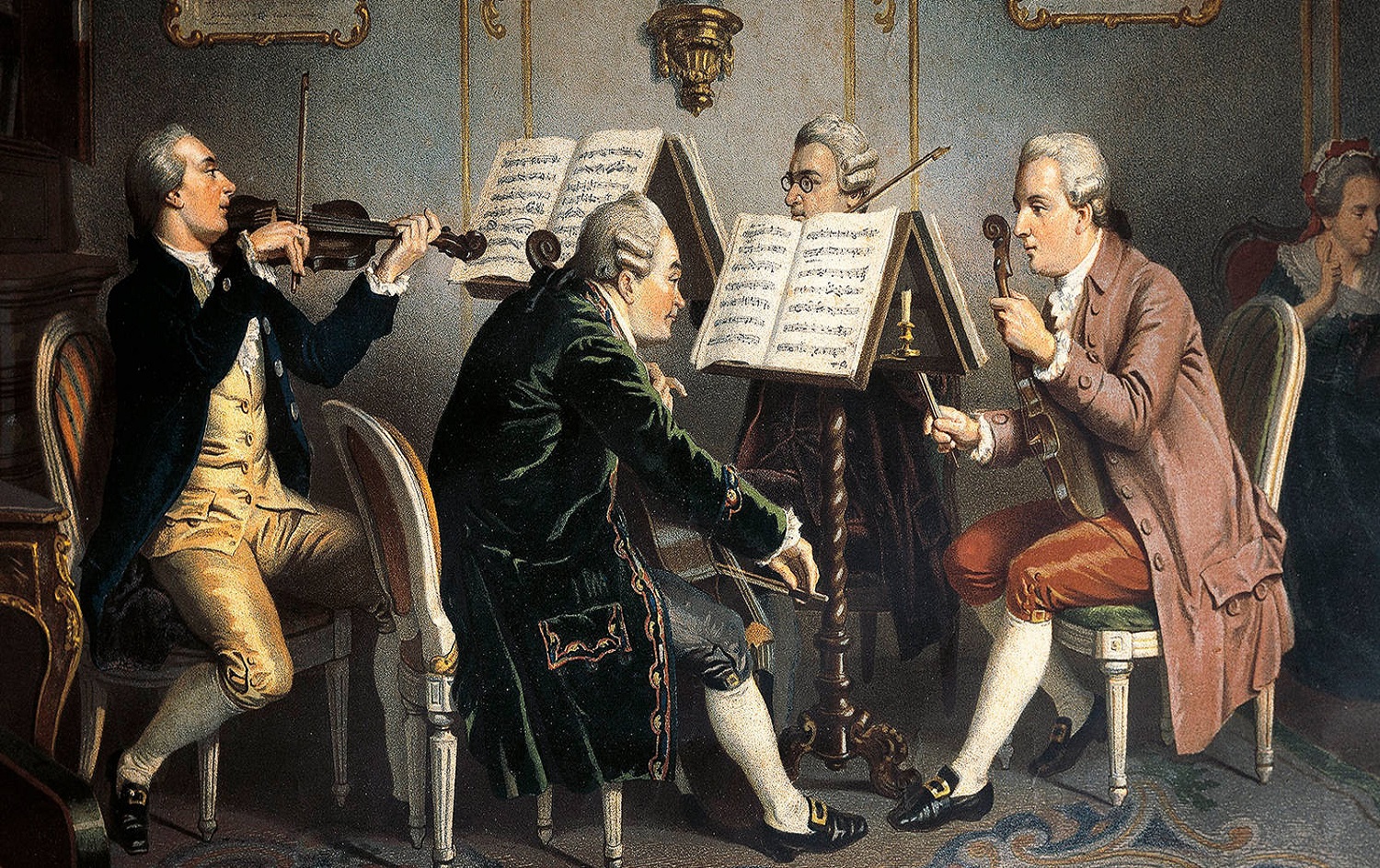
The string quartet also became a central genre, allowing composers to explore intricate musical relationships between four instrumental voices.
One of the most influential composers of the early Classical period was Joseph Haydn, frequently described as the father of the symphony and the string quartet because of his decisive contributions to the development and consolidation of these genres.
Haydn composed more than one hundred symphonies and numerous string quartets, establishing structural and stylistic models that profoundly influenced subsequent composers.
Wolfgang Amadeus Mozart represents another extraordinary figure of the Classical period. His compositions demonstrate exceptional melodic invention, formal elegance, harmonic sophistication, and dramatic sensitivity.
Mozart produced masterpieces across virtually every major musical genre of his time, including symphonies, concertos, operas, chamber music, and sacred compositions.
Among his most celebrated works are The Magic Flute, Don Giovanni, The Marriage of Figaro, the Symphony No. 40 in G Minor, and the Requiem in D Minor.
Ludwig van Beethoven occupies a particularly important position in the history of classical music. Although his early compositions belong firmly to the Classical tradition, his later works increasingly challenged established conventions and anticipated the expressive intensity of Romanticism.
His symphonies, piano sonatas, string quartets, and concertos expanded the emotional, structural, and technical possibilities of instrumental music.
The Symphony No. 3 in E-flat Major, known as the Eroica, marked a major turning point in symphonic composition. Its scale, dramatic development, and expressive ambition challenged the conventions of the eighteenth-century symphony.
Beethoven’s Symphony No. 9, incorporating Friedrich Schiller’s Ode to Joy in its final movement, became one of the most influential and symbolically significant works in the entire Western musical tradition.
The Classical period established many of the structural principles that continue to influence orchestral and chamber music today.
6. The Romantic Period (Approximately 1820–1900)
The Romantic period represented a profound transformation in musical aesthetics. Whereas Classical composers frequently emphasized formal balance and structural clarity, Romantic composers increasingly explored individual expression, emotional intensity, imagination, and the subjective experience of the human condition.
This artistic movement developed alongside broader cultural changes associated with Romantic literature, philosophy, nationalism, and the growing importance of individual identity.
Music became an especially powerful medium for expressing personal emotions, dramatic narratives, natural landscapes, historical subjects, and philosophical ideas.
One of the most significant developments was the expansion of the orchestra. Composers introduced new instruments, increased the number of performers, and explored a wider range of instrumental colors and dynamic possibilities.
Harmony also became increasingly adventurous. Chromaticism, modulation, and complex harmonic relationships allowed composers to create greater emotional tension and expressive ambiguity.
The piano became one of the defining instruments of the Romantic era. Improvements in piano construction expanded its dynamic range, technical capabilities, and expressive potential.
Frédéric Chopin transformed piano composition through works that combined lyrical beauty, harmonic innovation, and extraordinary technical refinement. His nocturnes, mazurkas, polonaises, études, and ballades remain central to the piano repertoire.
Franz Liszt expanded the possibilities of virtuoso performance and developed the symphonic poem, an orchestral genre designed to express a literary, historical, or philosophical subject.
Felix Mendelssohn, Robert Schumann, and Johannes Brahms contributed significantly to the development of Romantic instrumental and orchestral music, each maintaining a distinctive relationship with Classical formal traditions.
Hector Berlioz explored innovative orchestration and dramatic musical storytelling. His Symphonie fantastique became a landmark of programmatic orchestral music, using recurring musical themes to represent characters, memories, and psychological experiences.
Richard Wagner transformed opera through his concept of the Gesamtkunstwerk, or total work of art, in which music, drama, poetry, and theatrical design were integrated into a unified artistic experience.
His operatic works, particularly Tristan und Isolde and The Ring of the Nibelung, profoundly influenced subsequent developments in harmony, orchestration, and dramatic composition.
Giuseppe Verdi became one of the greatest figures in Italian opera. His works combine powerful dramatic situations with memorable melodies and a profound understanding of the human voice. Among his most celebrated operas are La Traviata, Rigoletto, and Aida.
Nationalism also became an important force in Romantic music. Composers increasingly incorporated folk melodies, national dances, historical subjects, and regional musical characteristics into their compositions.
Important representatives included Bedřich Smetana and Antonín Dvořák in Bohemia, Edvard Grieg in Norway, Jean Sibelius in Finland, and Modest Mussorgsky, Pyotr Ilyich Tchaikovsky, and Nikolai Rimsky-Korsakov in Russia.
The Romantic period reached extraordinary expressive and technical heights, expanding the possibilities of musical composition and establishing many works that remain central to concert life.
7. The Late Romantic Period and the Turn of the Twentieth Century (Approximately 1880–1914)
During the late nineteenth and early twentieth centuries, Romantic musical language became increasingly expansive and harmonically complex.
Composers experimented with larger orchestras, extended harmonic structures, sophisticated orchestration, and increasingly ambitious musical forms.
Gustav Mahler became one of the most important figures of this transition. His symphonies combine immense orchestral forces, philosophical reflection, folk-inspired melodies, and profound emotional contrasts.
Richard Strauss explored the expressive possibilities of the symphonic poem and opera. Works such as Also sprach Zarathustra, Don Juan, and Salome demonstrate his extraordinary command of orchestration and musical drama.
In France, Claude Debussy developed a distinctive musical language that challenged traditional harmonic expectations. His compositions frequently employ modal scales, whole-tone structures, unconventional chord progressions, and subtle orchestral colors.
Although often associated with Impressionism, Debussy’s music resists simple classification. His compositions sought to create musical atmospheres and sensations rather than relying exclusively on conventional thematic development.
Maurice Ravel also explored innovative harmonic and orchestral techniques, producing works distinguished by precision, elegance, and extraordinary instrumental color.
The late Romantic period therefore represents an important transition between nineteenth-century tonal traditions and the musical experimentation that would characterize the twentieth century.
8. The Twentieth Century: Modernism and Musical Revolution (Approximately 1900–2000)
The twentieth century witnessed perhaps the most radical transformation in the history of classical music.
Political upheavals, technological developments, industrialization, world wars, new philosophical movements, and changing cultural identities profoundly influenced musical composition.
Composers increasingly questioned the conventions of tonality, traditional musical forms, rhythmic organization, and the relationship between sound and artistic expression.
One of the most influential movements was Impressionism, particularly associated with Claude Debussy and Maurice Ravel. Their music emphasized atmospheric effects, unconventional harmonies, and sophisticated orchestral colors.
Another important development was Expressionism, which sought to communicate intense psychological states and emotional experiences.
Arnold Schoenberg became a central figure in this movement. His early twentieth-century compositions progressively abandoned traditional tonal organization, leading to the development of atonality.
He subsequently developed the twelve-tone technique, a compositional system in which all twelve notes of the chromatic scale are organized into a structured sequence, or tone row, serving as the basis for a composition.
Schoenberg’s innovations profoundly influenced the development of twentieth-century music, particularly through the work of his students Alban Berg and Anton Webern.
Igor Stravinsky became another defining figure of musical modernism. His ballet The Rite of Spring (1913) caused a sensation through its powerful rhythms, unconventional harmonies, and radical orchestration.
The work challenged established musical expectations and became one of the most influential compositions of the twentieth century.
Other composers explored different responses to the changing musical environment.
Béla Bartók incorporated elements of Eastern European folk music into sophisticated modern compositions, combining traditional melodic and rhythmic materials with innovative harmonic and structural techniques.
Sergei Prokofiev developed a distinctive musical language characterized by rhythmic energy, melodic clarity, and striking contrasts.
Dmitri Shostakovich produced symphonies, string quartets, and concertos that reflected the psychological and political tensions of his historical environment.
In the United States, Charles Ives experimented with polytonality, unconventional rhythms, and the simultaneous combination of different musical materials. Aaron Copland became known for a musical style that incorporated American cultural influences and accessible orchestral language.
The twentieth century also witnessed the development of several important compositional movements.
Neoclassicism represented a renewed interest in the formal clarity and structural principles of earlier musical traditions, often reinterpreted through modern harmonic and rhythmic language.
Serialism expanded Schoenberg’s twelve-tone principles into broader systems governing not only pitch but also rhythm, dynamics, and other musical parameters.
Minimalism, which emerged prominently during the second half of the century, emphasized repetition, gradual transformation, rhythmic patterns, and the exploration of musical processes. Composers such as Steve Reich, Philip Glass, and Terry Riley became major representatives of this movement.
Electronic music also transformed the possibilities of composition. The development of recording technologies, synthesizers, magnetic tape, and digital sound processing enabled composers to explore sounds that had previously been unavailable through conventional instruments.
Edgard Varèse, Pierre Schaeffer, Karlheinz Stockhausen, and later composers contributed significantly to the development of electronic and experimental music.
The twentieth century did not produce a single dominant musical style. Instead, it established an extraordinarily diverse artistic environment in which multiple aesthetic approaches developed simultaneously.
9. Contemporary Classical Music (2000–Present)
Contemporary classical music continues to develop through an extraordinary diversity of compositional approaches, technological resources, and cultural influences.
Rather than representing a unified movement, contemporary classical music encompasses a broad range of aesthetic perspectives. Some composers continue to explore the possibilities of modernism and experimental composition, while others embrace tonal harmony, lyrical melodies, minimalist techniques, and traditional instrumental forms.
Technology has become an increasingly important component of musical creation and performance. Digital composition software, electronic instruments, sophisticated recording systems, and computer-assisted sound design have expanded the possibilities available to composers.
Contemporary orchestral and chamber music also reflect a growing awareness of cultural diversity and the historical limitations of the traditional Western classical canon.
Composers increasingly draw inspiration from musical traditions outside Europe, incorporating elements of different cultures into contemporary artistic languages.
Among the prominent contemporary composers are John Adams, known for his contributions to minimalist and post-minimalist orchestral music; Thomas Adès, recognized for his sophisticated compositional language; Kaija Saariaho, whose works explore the relationship between acoustic and electronic sound; and Caroline Shaw, whose compositions combine diverse musical influences and experimental approaches.
Other important contemporary composers include Arvo Pärt, whose distinctive approach to composition is frequently associated with spiritual minimalism, and Max Richter, whose work combines classical instrumentation with electronic and minimalist elements.
Contemporary classical music also benefits from the increasing accessibility of musical recordings, digital distribution, online archives, and international performance networks.
These developments have enabled audiences to discover a broader range of historical and contemporary repertoire, while allowing musicians and composers to reach listeners beyond traditional concert institutions.
Despite the diversity of contemporary approaches, many composers continue to engage with fundamental questions that have shaped classical music throughout its history: the relationship between structure and expression, the possibilities of sound, the role of tradition, and the capacity of music to communicate human experience.
10. The Evolution of Musical Instruments and the Orchestra
The history of classical music is inseparable from the evolution of musical instruments and the development of the orchestra.
During the medieval and Renaissance periods, instrumental ensembles were relatively small and frequently included recorders, lutes, viols, early keyboard instruments, and various percussion instruments.
The Baroque period witnessed the increasing standardization of instrumental families and the emergence of the modern orchestral tradition.
The violin family became particularly important, while the harpsichord, organ, and other continuo instruments played essential roles in ensemble performance.
During the Classical period, the orchestra developed a more standardized structure based on strings, woodwinds, brass, and percussion. The clarinet became increasingly prominent, and composers explored greater possibilities for orchestral balance and instrumental interaction.
The nineteenth century brought substantial technological improvements to instruments, particularly through the development of the modern piano and improvements to brass instruments through valve mechanisms.
These innovations expanded the expressive and technical capabilities of orchestral musicians.
The Romantic orchestra became significantly larger and more diverse, allowing composers to create increasingly complex textures and powerful dramatic effects.
During the twentieth and twenty-first centuries, electronic instruments and digital technologies further expanded the concept of musical instrumentation.
Today, classical music can be performed by traditional symphony orchestras, chamber ensembles, solo instrumentalists, electronic musicians, and combinations of acoustic and digital resources.
11. The Importance of Classical Music in Western Culture
Throughout its history, classical music has maintained a significant relationship with intellectual, cultural, and artistic development.
It has served religious institutions, royal courts, aristocratic households, public concert organizations, educational establishments, and modern cultural institutions.
Its development has also reflected changing social structures. Whereas medieval musical production was closely connected to religious institutions, later periods witnessed the emergence of professional composers, public concert audiences, commercial music publishing, and increasingly independent artistic careers.
The nineteenth century was particularly important in establishing the modern concept of the composer as an individual creative genius whose works could transcend their original historical circumstances.
The growth of public concert halls, music conservatories, orchestras, and publishing institutions helped establish classical music as an international artistic tradition.
Today, classical music remains an important component of cultural heritage and musical education. Its repertoire provides opportunities to study historical aesthetics, musical structures, instrumental techniques, and the relationship between artistic creation and society.
Furthermore, classical music continues to influence contemporary musical genres, film scores, popular music, music education, and the broader cultural imagination.
Its historical importance is therefore not limited to the preservation of old compositions. It also resides in its continuing capacity to inspire new interpretations, artistic experimentation, and intellectual engagement.
Conclusion
The history of classical music is a remarkable account of artistic evolution, intellectual exploration, and cultural transformation.
From the philosophical foundations of ancient Greece to the sacred chants of medieval Europe, from the contrapuntal sophistication of the Renaissance to the dramatic expressiveness of the Baroque, each historical period contributed essential elements to the development of Western musical art.
The Classical period established enduring models of formal organization and musical clarity, while the Romantic era expanded the expressive possibilities of composition and performance. The twentieth century challenged established conventions and introduced unprecedented musical experimentation, while contemporary composers continue to redefine the boundaries of the tradition.
Despite the enormous stylistic differences separating a medieval Gregorian chant, a Baroque fugue, a Classical symphony, a Romantic piano concerto, and a contemporary electronic composition, these works remain connected through a shared historical continuum of artistic inquiry.
Classical music is not simply a collection of compositions preserved from the past. It is a living cultural tradition, continually reinterpreted through performance, scholarship, education, and creative expression.
Its enduring significance lies in its ability to transcend historical boundaries and communicate ideas, emotions, and experiences through the universal language of sound.
To study the history of classical music is therefore to explore not only the development of an artistic discipline but also the intellectual and cultural history of the societies that created it. Across centuries, composers and musicians have continually transformed musical possibilities, leaving behind a body of work that remains one of humanity’s most extraordinary artistic legacies.
Comments are closed