
Anton Bruckner: A Complete Biography
Introduction
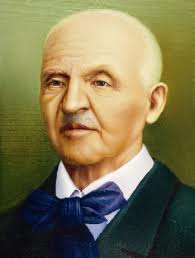
Anton Bruckner (1824–1896) was an Austrian composer whose monumental symphonies and deeply spiritual music marked a significant transition from Romanticism to the modern era. Revered for his sacred choral works and orchestral masterpieces, Bruckner was often misunderstood in his lifetime due to his idiosyncratic style, provincial background, and deep humility. Today, however, he is recognized as one of the great symphonists of the 19th century, admired for his innovative structures, harmonic boldness, and spiritual depth.
Childhood
Anton Bruckner was born on September 4, 1824, in the small village of Ansfelden, near Linz, in Upper Austria. His father, Anton Senior, was a schoolteacher and organist, and his mother, Theresia Helm, came from a musical family. Music was a part of daily life for the Bruckners, and young Anton displayed musical talent from an early age.
At age four, Bruckner began playing the violin and showed a keen ear for harmony. His early education was intertwined with music and religious instruction. After his father’s death in 1837, Bruckner was sent to the monastery of St. Florian, a formative institution that would play a central role in his life and work. The grandeur of the abbey’s Baroque architecture and the resonance of its organ left a profound impression on the boy.
Youth
Bruckner’s teenage and early adult years were shaped by rigorous musical training and a strong work ethic. At St. Florian, he became a chorister and studied violin, organ, and music theory. He was so gifted as an organist that he was soon asked to substitute for his teachers.
By 1845, he earned a teaching certificate and began working as a schoolteacher and organist in Windhaag and later in Kronstorf. These were difficult years, marked by isolation, low wages, and limited musical opportunities. Despite this, Bruckner remained devoted to his studies. He voraciously studied counterpoint and harmony, modeling himself after J.S. Bach.
In 1855, he moved to Linz and began studying with Simon Sechter, one of Vienna’s leading theorists. Under Sechter’s strict tutelage, Bruckner spent six years mastering harmony and counterpoint before turning to composition. This late-blooming development would become a hallmark of his career.
Adulthood
Bruckner’s mature life was a combination of religious devotion, relentless self-doubt, and growing artistic confidence. In 1868, after years of intense training, he was appointed professor of harmony and counterpoint at the Vienna Conservatory, a prestigious position that marked his arrival on the Austrian musical scene.
Despite this, Bruckner remained insecure, especially when comparing himself to more urbane and worldly composers like Brahms and Wagner. His devout Catholicism and rural upbringing made him a cultural outsider in cosmopolitan Vienna. He developed an obsessive need for academic validation, often submitting works for critique and making numerous revisions in response to his critics.
His admiration for Richard Wagner—whose musical innovations he deeply respected—placed him in the middle of Vienna’s famous musical divide between the “Wagnerians” and the more conservative Brahms circle. Though Bruckner and Wagner met only a few times, Wagner’s music inspired Bruckner to pursue large-scale symphonic writing.
Personally, Bruckner was known for his awkward social manner and unsuccessful romantic interests. He remained a lifelong bachelor and was often mocked for his provincial accent, peculiar habits, and obsessive cataloging of young women’s names and ages. Yet, despite these eccentricities, his colleagues and students respected him for his kindness, sincerity, and humility.
Major Compositions
Bruckner’s greatest legacy lies in his symphonies—massive, spiritual, and architecturally complex works that expanded the scope of the genre.
- Symphony No. 1 in C Minor (1866): Often called the “keckes Beserl” (saucy maid) by Bruckner, this early work already displays his signature use of brass and dramatic contrasts.
- Symphony No. 3 in D Minor (1873): Dedicated to Richard Wagner, this symphony caused controversy upon its premiere but later gained appreciation for its bold structure.
- Symphony No. 4 in E-flat Major, “Romantic” (1874, rev. 1880–81): One of his most popular works, it evokes medieval landscapes, hunting scenes, and spiritual quests.
- Symphony No. 5 in B-flat Major (1876): Sometimes called the “Pizzicato Symphony,” it is an immense contrapuntal achievement and one of Bruckner’s most intellectually demanding works.
- Symphony No. 7 in E Major (1881–83): A turning point in his career, it was a critical and popular success, especially its deeply moving Adagio, written in anticipation of Wagner’s death.
- Symphony No. 8 in C Minor (1884–87, rev. 1890): Often considered his greatest symphony, it is a monumental work filled with apocalyptic grandeur and spiritual yearning.
- Symphony No. 9 in D Minor (1891–96): Left incomplete at his death, the Ninth Symphony is a profound musical testament. The three finished movements—particularly the Adagio—are some of the most mystical and transcendent music ever written.
In addition to his symphonies, Bruckner composed sacred choral works such as the Te Deum, Masses in D minor, E minor, and F minor, and numerous motets that highlight his contrapuntal mastery and religious fervor.
Death
Bruckner died on October 11, 1896, in Vienna, having struggled with poor health and fatigue during the final years of his life. He spent his last days feverishly working on the Ninth Symphony, which he dedicated “to my dear God.” He passed away before completing the final movement, leaving behind sketches and fragments that would later be studied and completed by musicologists.
In accordance with his wishes, Bruckner was buried beneath the organ of the monastery at St. Florian, the place that had inspired his earliest musical dreams. His tomb bears silent witness to the unity of his spiritual and artistic life.
Conclusion
Anton Bruckner’s legacy is that of a composer who dared to be different—who pursued the sublime in an age that often demanded the fashionable. His music, misunderstood in his lifetime for its originality and depth, has since come to be regarded as one of the most significant contributions to the symphonic repertoire.
Though often plagued by self-doubt and critical resistance, Bruckner remained true to his inner voice. Today, his symphonies are performed around the world and admired for their profound spirituality, architectural vision, and emotional power. In the pantheon of great composers, Bruckner stands as a unique and deeply moving voice—a humble servant of both God and music.
Comments are closed