
Carl Philipp Emanuel Bach – A Complete Biography
Introduction
Carl Philipp Emanuel Bach (1714–1788) was the most innovative and widely admired composer between the late Baroque and high Classical eras. His music—restless, expressive, and often startling—embodied the empfindsamer Stil (“sensitive style”) and shaped how later composers thought about form, drama, and keyboard expression. Contemporaries recognized his stature: Joseph Haydn studied his treatise, and Mozart famously remarked, “He is the father, we are the children,” a tribute aimed at Emanuel, not Johann Sebastian.
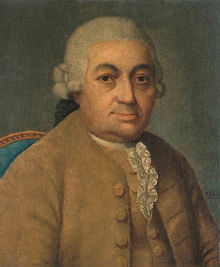
Childhood
Born on March 8, 1714, in Weimar, C. P. E. Bach was the second surviving son of Johann Sebastian and Maria Barbara Bach. One of his godfathers was Georg Philipp Telemann. After the family moved to Leipzig in 1723 for J. S. Bach’s post at the Thomasschule, Emanuel studied at the school and later wrote that all of his composition and keyboard training came directly from his father.
Youth
Although music was his vocation, Bach studied law in his youth—first in Leipzig and then at Frankfurt (Oder), where he took his degree in 1735. The legal studies did not distract him for long. Within a few years he was making his way as a keyboard virtuoso and flexible composer, absorbing his father’s craft while adopting the lighter, more emotionally mercurial idiom that would define his voice.
Adulthood
In 1740 Bach became harpsichordist to Frederick II (“the Great”) in Berlin and Potsdam, a prestigious but exacting court post he held for nearly three decades. There he married in 1744, built his reputation as a performer and teacher, and issued the first volume of his landmark Essay on the True Art of Playing Keyboard Instruments in 1753, followed by a second volume in 1762. The treatise codified fingering, ornamentation, and performance practice for a generation of players and was praised by leading composers of the time.
In 1768 he left Prussia to succeed his godfather Telemann as music director of the principal churches in Hamburg. The Hamburg years brought an outpouring of oratorios, Passions, church cantatas, and instrumental works—including daring symphonies that pushed harmony, texture, and rhetoric far beyond courtly taste.
Major Compositions
- Essay on the True Art of Playing Keyboard Instruments (1753/1762): A groundbreaking guide to keyboard playing, shaping technique and expression across Europe.
- Six String Symphonies, Wq 182 (1773): Commissioned by Baron Gottfried van Swieten; compact, radical essays in orchestral rhetoric that influenced later Classicism.
- Four Orchestral Symphonies with 12 Obbligato Parts, Wq 183 (1775–76): Expanded orchestration and bold musical drama.
- Magnificat in D, Wq 215: Composed in Berlin in 1749 and revised in Hamburg; one of his largest sacred works.
- Heilig (Sanctus), Wq 217: A double-choir piece from 1779, praised for its grandeur.
- Die Auferstehung und Himmelfahrt Jesu, Wq 240 (1774; published 1787): A celebrated oratorio reflecting Bach’s mature sacred style.
- Prussian Keyboard Sonatas, Wq 48 (1742): Early works that demonstrate Bach’s highly personal sonata style.
- Württemberg Keyboard Sonatas, Wq 49 (1742–43): Influential in shaping mid-18th-century keyboard writing.
- Collections für Kenner und Liebhaber (1779–1787): Six self-published volumes of sonatas, rondos, and fantasias, summing up his mature keyboard style.
Death
Bach died in Hamburg on December 14, 1788. He was laid to rest in the crypt of St. Michael’s Church (Michaeliskirche), where his grave can still be visited.
Conclusion
C. P. E. Bach stood at the fault line between eras. From his early years under the tutelage of Johann Sebastian to his work as a Berlin court musician and, finally, Hamburg’s civic Kapellmeister, he forged a style that prized surprise, nuance, and deeply felt expression. His keyboard treatise became a universal “school of schools,” his symphonies and sonatas reset expectations for form and drama, and his choral works brought a fresh spirit to Lutheran sacred music. Haydn, Mozart, and Beethoven all looked to him as a guiding figure, acknowledging his role as a pioneer of a new musical language that echoed throughout the Classical period.
Comments are closed