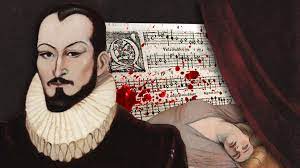
Carlo Gesualdo – A Complete Biography
Introduction
Carlo Gesualdo, the Prince of Venosa, was a man of stark contradictions. A composer of sublime and forward-looking music, he was also a figure of notoriety, forever defined by the brutal murder of his first wife and her lover. His life, a tumultuous blend of artistic genius and personal demons, has fascinated and horrified scholars and music lovers for centuries. This biography seeks to explore the complex and often enigmatic figure of Carlo Gesualdo, examining his life from his aristocratic upbringing to his final, isolated years, and delving into the extraordinary music that emerged from such a troubled soul. His work, characterized by its intense chromaticism and emotional depth, stands as a testament to a unique and tormented creative spirit, a composer whose life was as dramatic as his music.

Childhood
Carlo Gesualdo was born into a prominent noble family in Venosa, Italy, likely on March 30, 1566 . His family had acquired the principality of Venosa in 1560 from King Philip II of Spain . His father, Fabrizio II, married Geronima Borromeo, niece of Pope Pius IV, further solidifying the family’s standing . Carlo was the second-born son, named after his maternal uncle, Carlo Borromeo, who would later be canonized as a saint .
His early life was marked by tragedy; his mother died when he was only seven years old . Following this, he was placed under the care of his uncle Alfonso, the Archbishop of Naples . As the second son, Carlo was initially not expected to inherit the family estate, allowing him to pursue artistic interests . However, this changed dramatically in 1584 with the untimely death of his older brother, Luigi, making Carlo the designated successor and placing the responsibility of the family line upon him .
Despite the lack of detailed records about his early childhood, it is known that music played a significant role in his upbringing. His father, Duke Fabrizio, was a patron of the arts and employed musicians in his household, including the Netherlander Giovanni de Macque . There is speculation that Gesualdo received musical instruction from de Macque or Stefano Felis, who oversaw the printing of Gesualdo’s first published motet in 1586 . From an early age, Gesualdo showed a singular devotion to music, reportedly having little interest in anything else . He was proficient in playing the lute, harpsichord, and guitar .
Youth
With the unexpected death of his elder brother Luigi in 1584, Carlo Gesualdo’s life took an unforeseen turn. No longer free to simply pursue his musical passions, he was now the heir to the prestigious titles of Prince of Venosa and Count of Conza . This new responsibility necessitated a strategic marriage to secure the family lineage. In 1586, Gesualdo married his first cousin, Donna Maria d’Avalos . Maria was several years his senior and had been widowed twice before . The union was celebrated with great ceremony and feasting, and they soon had a son, Don Emmanuele .
Despite the outward appearance of a conventional aristocratic marriage, the relationship was fraught with tension. Donna Maria, a woman of renowned beauty, soon embarked on an affair with Fabrizio Carafa, the Duke of Andria, a man of considerable power and influence . This illicit relationship would culminate in the most infamous event of Gesualdo’s life. On the night of October 16, 1590, Gesualdo, having been informed of the affair, laid a trap . He caught Donna Maria and Fabrizio Carafa in flagrante delicto at the Palazzo San Severo in Naples and brutally murdered them both on the spot .
The double murder sent shockwaves through Neapolitan society. The official report of the incident detailed gruesome specifics, including the mutilation of the bodies and Gesualdo’s return to the scene to ensure their deaths . Despite the horrific nature of the crime, Gesualdo was not charged with murder. In the social code of the late Renaissance Italian nobility, such an act, committed to defend family honor against infidelity, was often considered justifiable . However, the event forever stained his legacy and deeply impacted his psyche, leading to a period of intense penitence, melancholy, and self-imposed isolation . To escape potential reprisals from the families of his victims, Gesualdo retreated to his family’s fortress in Gesualdo .
Adulthood
Following the murders, Gesualdo inherited the title of Prince of Venosa in 1591 after his father’s death . His retreat to his castle in Gesualdo marked the beginning of a period of self-imposed isolation, during which his musical creativity intensified . In 1593, he sought a second marriage, this time to Leonora d’Este, niece of Duke Alfonso II of Ferrara . This union was strategically important, as Ferrara was a vibrant center of artistic and musical innovation, particularly for madrigals .
Gesualdo traveled to Ferrara in 1594, not only to claim his new wife but also to immerse himself in the city’s rich musical environment . He was particularly keen to meet Luzzasco Luzzaschi, a leading composer of madrigals . During his two-year stay in Ferrara, Gesualdo was surrounded by some of Italy’s finest musicians, an experience that profoundly influenced his compositional style . It was during this time that he published his first two books of madrigals, with a third and fourth following shortly after . He also engaged with the concerto delle donne, a renowned ensemble of virtuoso female singers, for whom he likely composed music .
Despite the stimulating artistic environment, Gesualdo’s second marriage was troubled. Leonora d’Este eventually joined him in Venosa in 1597, but their relationship was strained, marked by accusations of abuse and infidelity from Leonora . She spent increasing amounts of time away from the isolated estate, leading to angry letters from Gesualdo . His mental state, already fragile after the murders, seemed to deteriorate further in this period of self-isolation . He was reported to have two concubines, Aurelia and Polisandra, whom Leonora accused of witchcraft, leading to a trial where the women confessed and were imprisoned within Gesualdo’s own castle . This bizarre episode further highlights the increasingly erratic and dark nature of Gesualdo’s later life. He rarely left his castle, finding solace only in music, and his most notoriously chromatic and difficult compositions were written during this time .
Major Compositions
Carlo Gesualdo’s musical output, though relatively small, is profoundly significant for its daring originality and emotional intensity. His compositions, primarily madrigals and sacred music, pushed the boundaries of harmony and counterpoint, anticipating musical developments that would not become common until centuries later .
His most celebrated works are his six books of madrigals, published between 1594 and 1611 . While his earlier books (Books I and II) show a mastery of the prevailing madrigal style, it is in his later works, particularly Books V and VI, that his unique and highly experimental style fully emerges . These madrigals are characterized by extreme chromaticism, sudden shifts in harmony, and disjunct melodic lines, all used to express intense emotional states, often related to pain, suffering, and death . Pieces like “Moro, lasso, al mio duolo” (Book VI) are prime examples of his audacious harmonic language, moving through distant keys with startling rapidity .
Beyond madrigals, Gesualdo also composed sacred music, most notably the Tenebrae Responsoria (1611) . These works, intended for Holy Week services, exhibit a similar level of chromatic intensity and emotional depth as his madrigals, reflecting the somber and penitential themes of the texts . His sacred compositions, though less frequently performed than his madrigals, are equally important in demonstrating his innovative approach to harmony and expression.
Gesualdo’s music was often seen as eccentric and difficult even by his contemporaries, but its profound emotional impact and technical complexity have earned him a unique place in music history. His willingness to break conventional rules to serve expressive ends makes him a fascinating figure, a composer whose personal turmoil seems to have fueled his artistic innovation .
Death
Carlo Gesualdo’s final years were marked by increasing physical and mental decline. He suffered from severe depression, paranoia, and possibly other psychological ailments, which were exacerbated by his self-imposed isolation and the lingering guilt from the murders . There are accounts of him engaging in masochistic practices, reportedly seeking to atone for his sins through self-inflicted pain . His health deteriorated significantly, and he became increasingly reclusive, rarely leaving his castle in Gesualdo.
Carlo Gesualdo died on September 8, 1613, at the age of 47, in his castle at Gesualdo . He was buried in the Church of Santa Maria delle Grazie in Gesualdo, a church he had helped to endow as part of his efforts at atonement . His death brought an end to a life that was as dramatic and unconventional as the music he created. Despite his aristocratic lineage and musical genius, his life remained overshadowed by the violent act of 1590, an event that inextricably linked his personal tragedy with his artistic legacy.
Conclusion
Carlo Gesualdo remains one of the most enigmatic and compelling figures in the history of classical music. His life, a tragic opera of privilege, passion, and violence, is inextricably linked to his extraordinary musical output. While his notoriety as a murderer has often overshadowed his artistic achievements, it is precisely this turbulent personal history that seems to have fueled the intense emotionality and daring experimentation found in his compositions .
Gesualdo’s madrigals, with their radical chromaticism and dissonant harmonies, stand as a testament to his unique genius and his willingness to defy conventional musical norms. He was a composer ahead of his time, exploring harmonic territories that would not be fully revisited until the late 19th century. His sacred music, though less frequently discussed, also showcases his profound expressive capabilities and innovative approach to text setting .
Ultimately, Carlo Gesualdo’s legacy is a complex tapestry woven from threads of artistic brilliance, personal torment, and historical infamy. He was a man deeply flawed, yet capable of creating music of profound beauty and unsettling power. His biography serves as a stark reminder that genius can emerge from the most unexpected and troubled of lives, leaving behind a body of work that continues to challenge, fascinate, and move listeners centuries after its creation.
Comments are closed