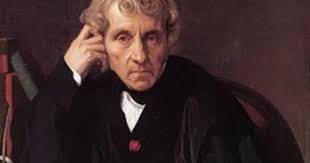
Luigi Cherubini – A Complete Biography
Introduction
Luigi Cherubini (born Maria Luigi Carlo Zenobio Salvatore Cherubini; 1760–1842) was an Italian-born composer who spent most of his professional life in France and whose music sits at the crossroads of Classical balance and early Romantic drama. He gained a reputation in his lifetime as a master of both opera and sacred music. Later generations admired his craftsmanship and contrapuntal skill, and major composers from Beethoven to Brahms praised his work.

Childhood
Cherubini was born in Florence in September 1760 into a large musical family. He was one of many children and received his first lessons from his father, Bartolomeo Cherubini, who worked as a maestro al cembalo. Early evidence shows that young Luigi was precocious: he entered the musical life of Florence and by his teens was already composing. His formative years exposed him to the Italian operatic tradition and the older contrapuntal practices that would remain important throughout his career.
Youth
In his late teens Cherubini moved beyond Florence to expand his musical education and professional prospects. By the mid-1780s he had begun to write operas and to establish a reputation that allowed him to travel. In 1785–1788 he made connections that led him to Paris, where he settled permanently in 1788. Paris would be the center of his activity for the rest of his life: there he adapted to French tastes, absorbed the influence of Gluck and other reformers, and began to produce operas that combined dramatic seriousness with tightly controlled musical architecture.
Adulthood
Cherubini’s adult career unfolded largely in Paris against the turbulent backdrop of the French Revolution, Napoleon’s rule, and the Bourbon Restoration. He wrote many operas—some highly successful, others less so—and increasingly concentrated on sacred music and chamber works. His compositional style evolved to fuse Italian melodic sensibility with rigorous counterpoint and orchestral color; critics and fellow composers recognized the intellectual depth of his technique.
In 1822 Cherubini was appointed director of the Paris Conservatoire, a post that made him one of the most influential musical figures in France. In that role he worked on musical education, adjudication, and the shaping of conservatory curricula. His Cours de contrepoint et de fugue (a treatise on counterpoint and fugue) was completed in 1835 and reflected his lifelong emphasis on contrapuntal craftsmanship. His conservatory years brought him into public disagreement with some younger composers, notably Hector Berlioz, but they also cemented his institutional legacy in French musical life.
Major compositions
Cherubini produced important works in several genres. His operas include Lodoïska, Médée (Medea), and Les deux journées (The Two Days), among others. Médée in particular is often singled out for its dramatic intensity and harmonic daring, qualities that point toward Romantic sensibilities.
In sacred music, Cherubini’s Requiem in C minor (1816) achieved wide acclaim and was performed at the funeral of Beethoven in 1827. His smaller sacred works, masses, and motets likewise display the austerity, contrapuntal skill, and ceremonial gravity that brought him official honors in France. Cherubini also wrote notable chamber music—six string quartets and a celebrated string quintet are part of a smaller but high-quality instrumental output that demonstrates his mastery of form and counterpoint.
Death
Luigi Cherubini died in Paris on 15 March 1842 at the age of 81. He was given significant official honors in his later years—he had been a chevalier and later commandeur of the Légion d’honneur and a member of the Académie des Beaux-Arts—and his burial at Père Lachaise placed him among the great artists of his era. His tomb, situated close to that of Frédéric Chopin, was designed with sculptural elements celebrating music.
Conclusion
Cherubini’s career bridged eras: trained in the late-18th-century Italian tradition, he matured in revolutionary and Napoleonic France and became a central figure in the 19th-century French musical establishment. He is remembered for operas that combined rigorous technique with dramatic feeling, for sacred music admired by his contemporaries and later composers, and for his influence as an educator and conservatory director. Although his name is less commonly cited than some of his more flamboyant successors, scholars and performers in the modern era continue to rediscover the craft, seriousness, and expressive power of his music.
Comments are closed