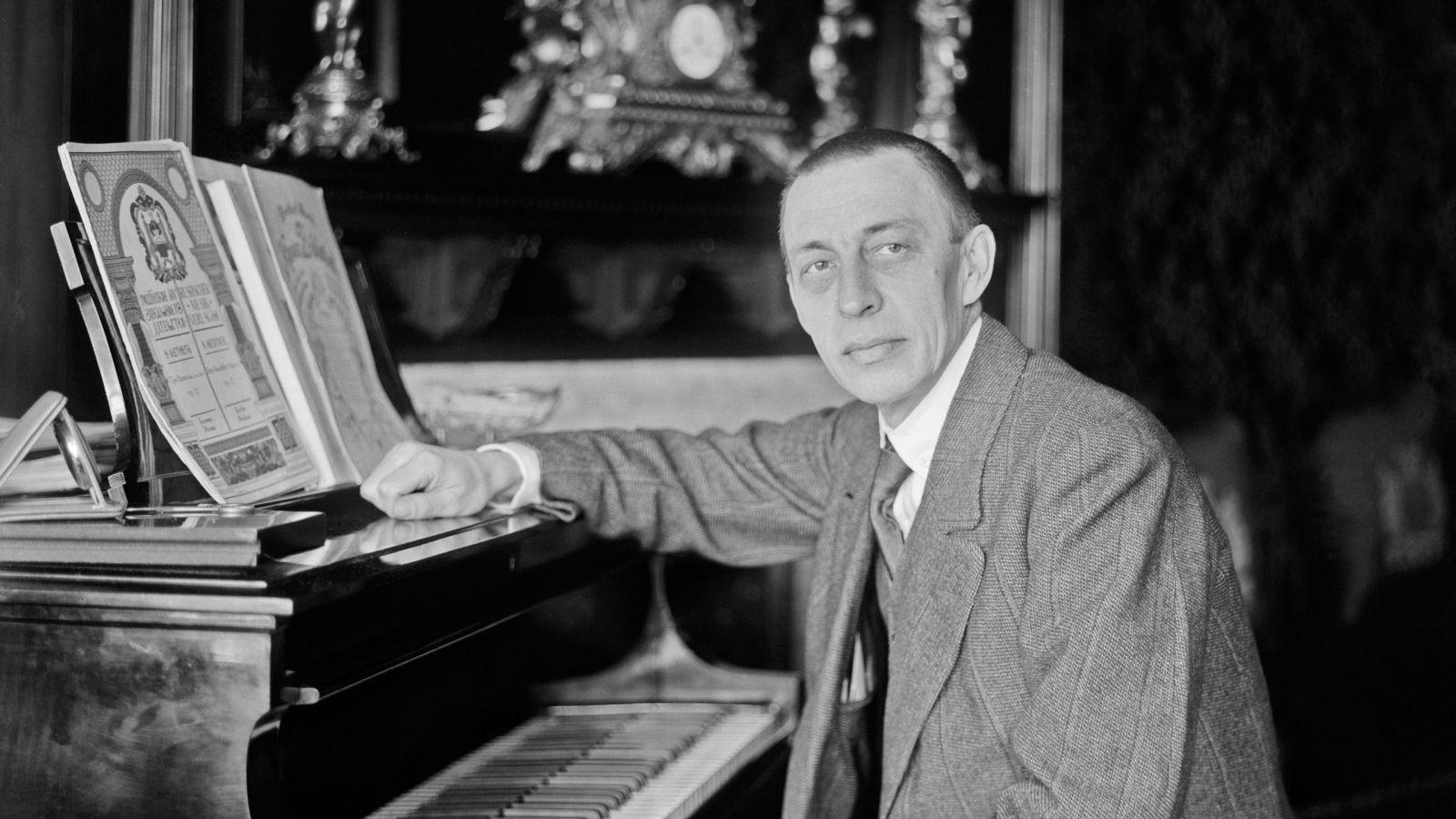
Sergei Rachmaninoff – A Complete Biography
INTRODUCTION
Sergei Vasilyevich Rachmaninoff (1873-1943) stands as one of the most influential figures in classical music history. A brilliant pianist, conductor, and composer, Rachmaninoff bridged the Romantic and Modern eras with his distinctive musical voice. His compositions are characterized by their emotional depth, technical complexity, and memorable melodies that continue to captivate audiences worldwide.
Rachmaninoff is widely considered one of the finest pianists of his day and, as a composer, one of the last great representatives of Romanticism in Russian classical music. His early influences included Tchaikovsky, Rimsky-Korsakov, and other Russian composers, but he developed a thoroughly personal idiom notable for its song-like melodicism, expressiveness, dense contrapuntal textures, and rich orchestral colors. The piano features prominently in Rachmaninoff’s compositional output, reflecting his extraordinary skills as a performer and his deep understanding of the instrument’s expressive and technical possibilities.
This biography explores the life and work of this remarkable musician, from his aristocratic Russian roots to his final years in America, examining the personal struggles and triumphs that shaped his artistic journey and left an indelible mark on classical music.

===========================================================================
CHILDHOOD
Sergei Rachmaninoff was born on April 1, 1873 (March 20 according to the Old Style calendar) in Semyonovo, near Staraya Russa in northwestern Russia. He was born into a family of Russian aristocracy with strong musical and military traditions. The family claimed descent from a legendary ancestor nicknamed “Rachman,” supposedly a grandson of Stephen III of Moldavia.
Rachmaninoff’s paternal grandfather, Arkady Alexandrovich, was a musician who had studied with the Irish composer John Field, establishing a musical lineage that would influence young Sergei. His father, Vasily Arkadievich Rachmaninoff (1841-1916), was a retired army officer and amateur pianist. His mother, Lyubov Petrovna Butakova (1853-1929), was the daughter of a wealthy army general who provided five estates as part of her dowry when she married Vasily. Sergei was the third of six children, with two brothers (Vladimir and Arkady) and three sisters (Yelena, Sofia, and Barbara).
When Sergei was just four years old, the family moved to another estate called Oneg, about 110 miles north of his birthplace. This move would later cause confusion, as Rachmaninoff himself would mistakenly cite Oneg as his birthplace in his adult life. It was at this young age that Rachmaninoff began his formal music education, with his mother organizing his first piano lessons. She quickly noticed his remarkable ability to reproduce passages from memory without a single wrong note.
Upon learning of the boy’s gift, his grandfather Arkady suggested hiring Anna Ornatskaya, a recent graduate of the Saint Petersburg Conservatory, to live with the family and provide formal piano instruction. Rachmaninoff would later dedicate his famous romance for voice and piano “Spring Waters” to Ornatskaya, acknowledging her early influence on his musical development.
Unfortunately, financial troubles soon befell the family. Rachmaninoff’s father, despite his military background and aristocratic standing, proved financially incompetent. He was forced to sell the family’s estates one by one to pay mounting debts. By 1882, the last estate in Oneg was auctioned off, and the family relocated to a small apartment in Saint Petersburg. This financial downfall meant that Sergei’s father could no longer afford to send him to the prestigious Page Corps for military training, as he had originally intended.
In 1883, at the age of ten, Rachmaninoff began studying music at the Saint Petersburg Conservatory under Gustav Kross, arranged by his former teacher Ornatskaya. That same year brought further hardship when his sister Sofia died of diphtheria at age 13, and his father abandoned the family for Moscow. In the wake of these difficulties, Rachmaninoff’s maternal grandmother, Sofia Litvikova Butakova, stepped in to help raise the children. She took particular interest in their religious upbringing, regularly taking young Sergei to Russian Orthodox Church services—an influence that would later manifest in his sacred choral compositions.
===========================================================================
YOUTH
In 1885, at the age of twelve, Rachmaninoff’s life took a significant turn when his cousin Alexander Siloti, an accomplished pianist who had studied with the strict disciplinarian Nikolai Zverev, suggested that Sergei should study under Zverev as well. This recommendation led to Rachmaninoff’s move to Moscow, where he would spend the next three years living in Zverev’s home as a boarding student.
Life under Zverev’s tutelage was demanding but formative. Rachmaninoff shared a bedroom with three other students, and they took turns practicing the piano for three hours each day on a strict rotation. Zverev’s harsh but effective teaching methods transformed Rachmaninoff from what some described as a “reckless lazy youngster” into an exceptionally disciplined and strong-willed musician. Years later, Rachmaninoff would acknowledge this influence, stating, “I owe to him the best I have in my character.”
While living with Zverev, Rachmaninoff also enrolled at the Moscow Conservatory, where his extraordinary talent quickly became apparent. After two years of study, the fifteen-year-old Rachmaninoff was awarded a prestigious Rubinstein scholarship and advanced to the upper division of the Conservatory. There, he studied piano with his cousin Alexander Siloti, counterpoint with Sergei Taneyev, and composition with Anton Arensky.
During his time at the Moscow Conservatory, Rachmaninoff was profoundly influenced by Pyotr Ilyich Tchaikovsky, who took a personal interest in the young musician’s development. After witnessing Rachmaninoff’s performance in theory examinations, Tchaikovsky reportedly declared, “For him I predict a great future.” This endorsement from Russia’s most celebrated composer boosted Rachmaninoff’s confidence and ambition.
By 1891, at just eighteen years old, Rachmaninoff had completed his first major work, the Piano Concerto No. 1 in F-sharp minor, which he dedicated to Siloti. That same year, he also composed the one-movement Youth Symphony and the symphonic poem Prince Rostislav, demonstrating his growing compositional prowess. When Siloti left the Moscow Conservatory at the end of the academic year, Rachmaninoff requested to take his final piano examinations a year early to avoid being assigned to a different teacher.
Rachmaninoff’s graduation from the Moscow Conservatory in 1892 was triumphant. For his final composition project, he created the one-act opera Aleko, based on Alexander Pushkin’s poem “The Gypsies,” completing the entire work in just seventeen days. The opera impressed the examination board so thoroughly that Rachmaninoff was awarded the Great Gold Medal, the Conservatory’s highest honor—a distinction that had only been awarded twice before in the institution’s history.
The success of Aleko led to its premiere at the Bolshoi Theatre in Moscow, with Tchaikovsky’s personal assistance in arranging the production. This early professional triumph, along with the publication of his famous Prelude in C-sharp minor (Op. 3, No. 2), established Rachmaninoff as one of Russia’s most promising young composers at the age of nineteen.
===========================================================================
ADULTHOOD
Following his graduation from the Moscow Conservatory, Rachmaninoff embarked on his career as a “Free Artist,” composing prolifically and beginning to establish himself as a pianist and conductor. His early professional years were marked by both creative triumphs and devastating setbacks that would shape the course of his life and artistic development.
In 1893, Rachmaninoff composed his Trio élégiaque No. 2 as a tribute to Tchaikovsky, whose sudden death that year deeply affected the young composer. Over the next few years, he produced several significant works, including the Fantaisie-Tableaux for two pianos (Suite No. 1, Op. 5), Six moments musicaux (Op. 16), and numerous romances for voice and piano.
However, Rachmaninoff’s promising trajectory was dramatically interrupted on March 15, 1897, when his Symphony No. 1 premiered in St. Petersburg. The performance, conducted by Alexander Glazunov (who was reportedly intoxicated), was disastrous. Critics savaged the work, with César Cui infamously comparing it to a programmatic depiction of the “Seven Plagues of Egypt” that would “delight the inhabitants of Hell.” This devastating public failure plunged the sensitive Rachmaninoff into a deep depression that lasted nearly four years, during which he composed almost nothing.
During this difficult period, Rachmaninoff supported himself primarily as a conductor and pianist. He formed important friendships with cultural figures including Leo Tolstoy, Anton Chekhov, and Feodor Chaliapin. In 1899, he made his first performance abroad in London, and in 1900 traveled to Italy, where he began sketches for his opera “Francesca da Rimini.”
Rachmaninoff’s creative paralysis finally ended in 1900, when he began treatment with Dr. Nikolai Dahl, a physician who used hypnotherapy to restore the composer’s confidence. The treatment proved successful, and in 1901, Rachmaninoff completed his Piano Concerto No. 2 in C minor, which he dedicated to Dr. Dahl. The concerto’s triumphant premiere marked Rachmaninoff’s return to composition and remains one of his most beloved works.
In 1902, following the success of his Piano Concerto No. 2, Rachmaninoff married his cousin Natalia Satina, after a three-year engagement. Their union required special permission, as marriages between first cousins were prohibited under Russian law. Using their military connections, they arranged a quiet ceremony in a chapel within a Moscow army barracks. The couple was gifted a house on the family estate at Ivanovka, where they spent their honeymoon before embarking on a three-month tour of Europe. On May 14, 1903, their first daughter, Irina Sergeyevna Rachmaninova, was born.
From 1904 to 1906, Rachmaninoff served as conductor of the Bolshoi Theatre, where he championed Russian opera and maintained high artistic standards. However, the political unrest surrounding the 1905 Russian Revolution created an unstable environment, and in 1906, Rachmaninoff relocated his family to Dresden, Germany, seeking a peaceful setting for composition.
During his three years in Dresden, Rachmaninoff composed several masterpieces, including his Symphony No. 2 in E minor (1907), the tone poem Isle of the Dead (1908), and the Piano Concerto No. 3 in D minor (1909). This last work was written specifically for his first American tour, which began in November 1909. The tour was a great success, with Rachmaninoff performing his new concerto with the New York Symphony Orchestra under the baton of Gustav Mahler.
Upon returning to Russia, Rachmaninoff purchased a country estate and continued to divide his time between performing, conducting, and composing. Between 1910 and 1917, he created some of his most significant works, including the choral symphony The Bells (1913), based on Edgar Allan Poe’s poem, and the All-Night Vigil (Vespers) for unaccompanied chorus (1915), one of the crowning achievements of Russian Orthodox sacred music.
The Russian Revolution of 1917 marked a decisive turning point in Rachmaninoff’s life. With the Bolshevik seizure of power, he lost his estate, his savings, and his homeland. In November 1917, Rachmaninoff and his family fled Russia, never to return. After a brief stay in Scandinavia, they arrived in New York on November 10, 1918, beginning a new chapter as émigrés in America.
===========================================================================
MAJOR COMPOSITIONS
Rachmaninoff’s compositional output spans various musical forms and genres, reflecting his evolution as an artist and the changing circumstances of his life. His works are characterized by their emotional expressiveness, technical sophistication, and distinctively Russian character, even as they incorporate broader European influences.
PIANO CONCERTOS:
Rachmaninoff composed four piano concertos and the Rhapsody on a Theme of Paganini, all showcasing his virtuosic pianism and gift for melody. The Piano Concerto No. 1 in F-sharp minor (Op. 1), written in 1891 and revised in 1917, reveals the influence of Grieg and Tchaikovsky but already displays Rachmaninoff’s individual voice. The Piano Concerto No. 2 in C minor (Op. 18, 1901) marked his recovery from depression and has become one of the most beloved works in the classical repertoire, known for its sweeping melodies and rich orchestration. The Piano Concerto No. 3 in D minor (Op. 30, 1909), composed for his first American tour, is renowned for its formidable technical demands and structural ingenuity. The Piano Concerto No. 4 in G minor (Op. 40, 1926, revised 1941), written after his emigration, shows a more modernist approach with its leaner textures and more complex harmonies. The Rhapsody on a Theme of Paganini (Op. 43, 1934), a set of 24 variations on Paganini’s 24th Caprice, brilliantly combines virtuosity with structural innovation.
SYMPHONIES:
Rachmaninoff composed three symphonies that trace his artistic development. The Symphony No. 1 in D minor (Op. 13, 1895), whose disastrous premiere led to his creative crisis, is a passionate, youthful work that has been rehabilitated in modern times. The Symphony No. 2 in E minor (Op. 27, 1907), written during his Dresden period, is a expansive, emotionally rich work that firmly established his symphonic credentials. The Symphony No. 3 in A minor (Op. 44, 1936), composed in exile, reflects a more concise, modernist approach while maintaining his characteristic lyricism.
PIANO SOLO WORKS:
Rachmaninoff’s works for solo piano include some of his most performed compositions. His 24 Preludes (Op. 3, No. 2; Op. 23; Op. 32) form a complete set in all major and minor keys, following Chopin’s example. The famous Prelude in C-sharp minor (Op. 3, No. 2) became so popular that Rachmaninoff grew tired of being asked to perform it. His Études-Tableaux (Op. 33 and Op. 39) combine technical challenges with vivid musical imagery. The two Piano Sonatas (No. 1 in D minor, Op. 28, 1908; No. 2 in B-flat minor, Op. 36, 1913, revised 1931) are substantial works that explore complex emotional landscapes. His Variations on a Theme of Chopin (Op. 22, 1903) and Variations on a Theme of Corelli (Op. 42, 1931) demonstrate his mastery of variation form.
CHORAL WORKS:
Rachmaninoff’s choral compositions reflect his deep connection to Russian Orthodox traditions. The Liturgy of St. John Chrysostom (Op. 31, 1910) and the All-Night Vigil (Vespers, Op. 37, 1915) are masterpieces of unaccompanied choral writing that draw on ancient Russian chants. The choral symphony The Bells (Op. 35, 1913), based on Edgar Allan Poe’s poem, combines chorus, orchestra, and soloists in a powerful meditation on the various stages of human life.
ORCHESTRAL WORKS:
Beyond his symphonies, Rachmaninoff composed several notable orchestral works. The symphonic poem Isle of the Dead (Op. 29, 1908), inspired by Arnold Böcklin’s painting, creates a haunting atmosphere through its 5/8 rhythm and dark orchestration. The Symphonic Dances (Op. 45, 1940), his final composition, synthesizes elements from throughout his career while incorporating more modern harmonies and rhythms.
CHAMBER AND VOCAL MUSIC:
Rachmaninoff’s chamber works include the Cello Sonata in G minor (Op. 19, 1901) and two Trios élégiaques. His songs for voice and piano, numbering over 80, are treasured for their beautiful melodies and sensitive text setting. The wordless Vocalise (Op. 34, No. 14, 1915) has become one of his most recognized compositions, arranged for numerous instrumental combinations.
OPERAS:
Though primarily known for his instrumental works, Rachmaninoff composed three operas: Aleko (1892), The Miserly Knight (1904), and Francesca da Rimini (1905). While not regularly performed today, they contain beautiful music that showcases his gift for drama and melody.
Rachmaninoff’s compositional output diminished significantly after his emigration from Russia in 1917. The demands of his concert career as a pianist, combined with homesickness and the changing musical landscape, led him to complete only six works during his 25 years in exile: the Piano Concerto No. 4, the Three Russian Songs for chorus and orchestra, the Variations on a Theme of Corelli, the Rhapsody on a Theme of Paganini, the Symphony No. 3, and the Symphonic Dances. Nevertheless, these late works show continued evolution and mastery, confirming his status as one of the great composers of his era.
===========================================================================
DEATH
By the early 1940s, Rachmaninoff’s health began to deteriorate noticeably. Years of rigorous concert touring, combined with his lifelong habit of heavy smoking, had taken their toll on the composer’s constitution. Despite his declining health, he maintained an active performance schedule, driven by both artistic commitment and financial necessity.
In late 1942, while on tour, Rachmaninoff began experiencing severe pain and fatigue. He was diagnosed with melanoma, an aggressive form of skin cancer that had already metastasized throughout his body. Recognizing the seriousness of his condition, Rachmaninoff and his wife moved from their home in New York to Beverly Hills, California, hoping that the milder climate might ease his suffering.
As his illness progressed, Rachmaninoff became increasingly nostalgic for his Russian homeland, which he had not seen in over 25 years. He expressed a desire to return to Russia before his death, but the ongoing Second World War and his deteriorating health made such a journey impossible. Instead, he found solace in listening to recordings of his own compositions and Russian folk music.
On February 17, 1943, despite his weakened condition, Rachmaninoff gave his final recital at the University of Tennessee in Knoxville. The program included works by Chopin, Liszt, and his own compositions. Those present noted that despite his illness, his playing retained its characteristic power and expressiveness.
Rachmaninoff’s condition worsened rapidly after this final performance. He became bedridden and was cared for by his wife Natalia and their daughters. On March 28, 1943, just four days before his 70th birthday, Sergei Rachmaninoff died at his home in Beverly Hills, California.
In accordance with his wishes, Rachmaninoff was buried at Kensico Cemetery in Valhalla, New York, rather than in his native Russia. His funeral service was held at the Holy Virgin Mary Russian Orthodox Church in Los Angeles and was attended by many prominent musicians and cultural figures. His pallbearers included fellow composers and musicians who had admired his artistry, including his friend Vladimir Horowitz.
News of Rachmaninoff’s death resonated throughout the musical world. Despite the ongoing war, tributes poured in from across the globe, acknowledging the loss of one of the last great representatives of Russian Romanticism. In a poignant coincidence, Rachmaninoff’s final composition, the Symphonic Dances (1940), contains a musical quotation from the Russian Orthodox “Alleluia” at its conclusion—a fitting farewell from a composer whose music often reflected his spiritual heritage.
At the time of his death, some critics predicted that Rachmaninoff’s popularity would fade, with the Grove Dictionary of Music and Musicians suggesting that “the enormous popular success some few of Rachmaninoff’s works had in his lifetime is not likely to last, and musicians never regarded them with much favor.” This assessment proved dramatically incorrect. In the decades following his death, Rachmaninoff’s music has only grown in popularity, with his piano concertos, symphonies, and solo piano works firmly established as cornerstones of the classical repertoire.
===========================================================================
CONCLUSION
Sergei Rachmaninoff’s life and work embody the complex transition from the Romantic era to the modern age in classical music. Born into the aristocratic traditions of Imperial Russia and dying in the commercial entertainment capital of Beverly Hills, his journey spanned not only continents but also profound cultural and artistic transformations. Throughout these changes, Rachmaninoff maintained an unwavering commitment to emotional expressiveness and technical excellence that continues to resonate with audiences worldwide.
As a composer, Rachmaninoff created a body of work that successfully bridged traditional Russian musical elements with Western European forms. His compositions are distinguished by their memorable melodies, rich harmonies, and masterful orchestration. While firmly rooted in the Romantic tradition, his later works show an awareness of modernist developments, even as he maintained his distinctive voice against the more radical experiments of his contemporaries.
As a pianist, Rachmaninoff set standards of technical precision, tonal beauty, and interpretive depth that remain benchmarks for performers today. His recordings, though made with the technological limitations of his era, continue to be studied for their remarkable clarity, rhythmic control, and emotional communication. His large hands, reportedly able to span twelve piano keys, allowed him to execute technical feats that few pianists could match, but it was his musicality rather than mere technique that distinguished his playing.
Rachmaninoff’s legacy extends beyond his compositions and performances. As a conductor, particularly during his tenure at the Bolshoi Theatre, he championed Russian music and maintained high artistic standards. As a cultural figure, he represented the preservation of pre-revolutionary Russian artistic values during a period of tremendous upheaval and displacement.
The enduring popularity of Rachmaninoff’s music contradicts the predictions of some contemporary critics who dismissed his work as overly sentimental or backward-looking. Time has vindicated his artistic choices, revealing the depth and craftsmanship beneath the immediate emotional appeal of his compositions. His Piano Concerto No. 2 consistently ranks among the most beloved classical works in audience surveys, while pianists continue to be challenged and inspired by his technical demands and expressive possibilities.
Perhaps most significantly, Rachmaninoff’s music speaks to the universal human experience of longing, loss, and transcendence. His personal experience of exile and nostalgia for his homeland infuses his later compositions with a poignancy that resonates across cultural boundaries. In a century marked by displacement and rapid change, his music offers both solace and catharsis.
As we continue to perform, record, and listen to Rachmaninoff’s music in the 21st century, we participate in the ongoing dialogue between tradition and innovation that characterized his creative life. His achievement reminds us that artistic authenticity lies not in following prevailing trends but in expressing genuine emotion through masterful craft—a lesson as relevant today as it was during Rachmaninoff’s remarkable journey from Semyonovo to Beverly Hills.
Comments are closed