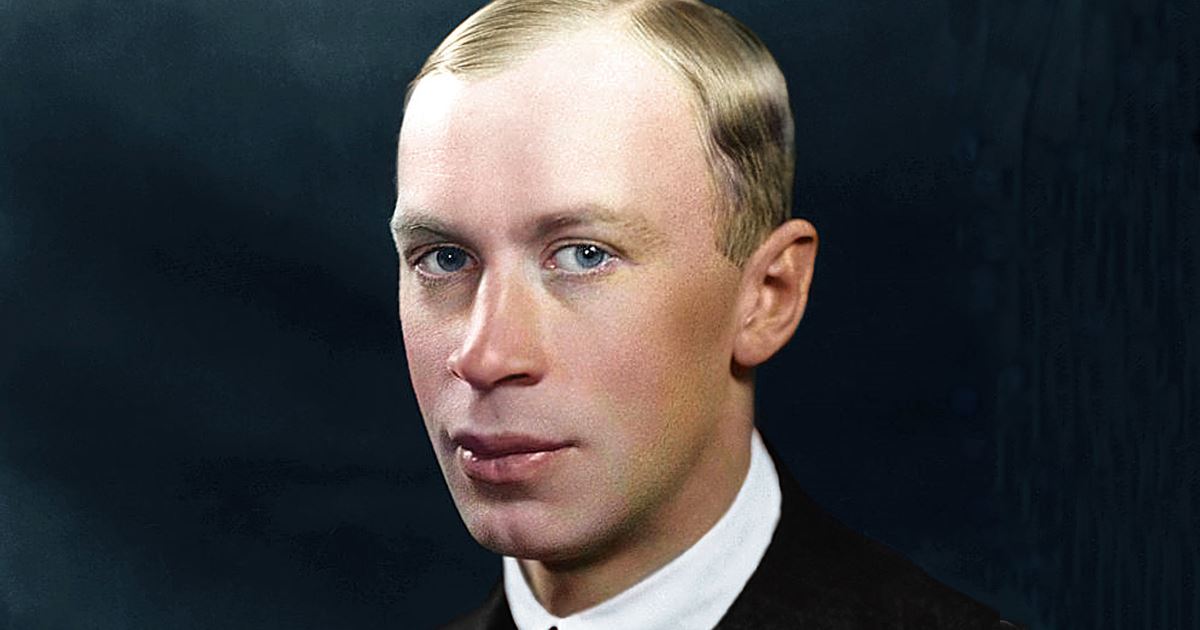
Sergei Prokofiev – A Complete Biography
INTRODUCTION
Sergei Sergeyevich Prokofiev (1891-1953) stands as one of the most significant and innovative composers of the 20th century. A brilliant pianist, conductor, and composer, Prokofiev created masterpieces across numerous musical genres that continue to captivate audiences worldwide. His distinctive musical voice combined traditional Russian elements with bold modernist innovations, creating a sound that was uniquely his own.
Known for his sharp wit, rhythmic vitality, and lyrical expressiveness, Prokofiev developed a musical language that balanced classical forms with daring harmonies and striking orchestration. His compositions range from the playful and satirical to the deeply emotional and profound, demonstrating remarkable versatility throughout his career.
Despite facing significant political and personal challenges during his lifetime, particularly after his return to the Soviet Union, Prokofiev’s creative output remained prolific and influential. His works include such widely recognized pieces as “Peter and the Wolf,” the ballet “Romeo and Juliet,” the opera “The Love for Three Oranges,” and the “Classical Symphony,” all of which showcase his distinctive melodic gifts and innovative approach to composition.
This biography explores the life and artistic journey of this remarkable musician, from his childhood in rural Ukraine through his international career and final years in Stalin’s Soviet Union, examining the personal circumstances and historical events that shaped his extraordinary musical legacy.
===========================================================================
CHILDHOOD
Sergei Prokofiev was born on April 27, 1891 (April 15 according to the Old Style calendar) in Sontsovka, a rural estate in what was then the Yekaterinoslav Governorate of the Russian Empire (now part of the Donetsk region of Ukraine). He was the only child of Sergei Alekseyevich Prokofiev, an agronomist from Moscow who managed the estate, and Maria Zitkova Prokofiev, a cultured woman from St. Petersburg.
Maria Prokofiev, having previously lost two daughters, devoted herself to nurturing her son’s musical talent. She was a capable pianist who regularly practiced works by Chopin and Beethoven in the evenings, which captivated young Sergei’s imagination. Recognizing her son’s extraordinary musical aptitude, she began teaching him piano when he was just four years old.
By the age of five, Prokofiev had composed his first piano piece, an “Indian Gallop,” which his mother notated for him. Interestingly, this early composition was written in the F Lydian mode (a major scale with a raised 4th scale degree), as the young Prokofiev reportedly felt a “reluctance to tackle the black notes” on the piano. This early creative impulse would soon blossom into more ambitious projects.
At the age of nine, Prokofiev composed his first opera, “The Giant,” as well as an overture and various other pieces. His mother, determined to provide him with the best musical education possible, would travel with him to Moscow and St. Petersburg, where he attended his first operas. These experiences made a profound impression on the young composer, and opera would remain his favorite genre throughout his life.
In 1902, when Prokofiev was eleven, his mother arranged a meeting with Sergei Taneyev, the director of the Moscow Conservatory. Impressed by the boy’s talent, Taneyev recommended that Prokofiev study with Alexander Goldenweiser. When this arrangement proved impossible, Taneyev suggested the composer and pianist Reinhold Glière, who spent the summers of 1902 and 1903 in Sontsovka teaching young Sergei theory, composition, and piano.
Glière later described Prokofiev’s mother as “a tall woman with beautiful, clever eyes… who knew how to create an atmosphere of warmth and simplicity about her.” Under her guidance and Glière’s tutelage, Prokofiev’s musical abilities developed rapidly, preparing him for the formal conservatory education that would follow.
These formative years in the Ukrainian countryside, surrounded by nature and nurtured by his parents’ encouragement, laid the foundation for Prokofiev’s distinctive musical voice. The rural setting of his childhood would later influence works like the “Scythian Suite” and various folk-inspired compositions, while the operatic performances he witnessed in Moscow and St. Petersburg would inspire his lifelong passion for dramatic musical forms.
===========================================================================
YOUTH
In 1904, at the age of thirteen, Prokofiev’s parents were persuaded to let him study music full-time at the St. Petersburg Conservatory. As one of the youngest students ever admitted to this prestigious institution, Prokofiev quickly distinguished himself with his extraordinary talent and strong-willed personality.
At the Conservatory, Prokofiev studied under several notable teachers, including Nikolai Rimsky-Korsakov, one of Russia’s most celebrated composers and a master orchestrator. However, Prokofiev’s rebellious nature and modernist leanings often put him at odds with the conservative musical establishment. He developed a reputation as an enfant terrible, deliberately provoking his teachers with bold harmonies and unconventional compositional techniques.
Despite these tensions, Prokofiev thrived academically. He completed his composition studies in 1909 and graduated with performance degrees in piano and conducting in 1914. His graduation performance was particularly memorable—rather than performing standard repertoire, he played his own First Piano Concerto (1911), winning the prestigious Anton Rubinstein Prize. The piece, with its dissonant harmonies and percussive piano writing, scandalized conservative critics, one of whom described it as “footballish.”
During his conservatory years, Prokofiev also began performing professionally with the St. Petersburg Evenings of Contemporary Music, which presented works by modern composers such as Debussy, Strauss, and Stravinsky, alongside Prokofiev’s own compositions. These performances helped establish his reputation as both a composer and pianist of exceptional ability.
In 1914, a pivotal moment in Prokofiev’s early career occurred when he met Sergei Diaghilev, the influential impresario of the Ballets Russes. Impressed by the young composer’s talent, Diaghilev commissioned a ballet on Russian themes, titled “Ala and Lolli.” Although Diaghilev ultimately rejected the score, possibly because it resembled Igor Stravinsky’s “The Rite of Spring,” Prokofiev reworked the music into his “Scythian Suite” for orchestra. The suite’s premiere in 1916 caused a sensation, with its primitive rhythms and bold orchestration establishing Prokofiev as a significant voice in modern music.
Diaghilev soon commissioned another ballet from Prokofiev, “Chout” (The Tale of the Buffoon), which would later become one of his first international successes. Meanwhile, the Mariinsky Theater commissioned Prokofiev to write an opera based on Fyodor Dostoevsky’s novel “The Gambler,” further cementing his growing reputation in Russian musical circles.
These formative years saw Prokofiev developing his distinctive musical language—characterized by sharp dissonances, driving rhythms, lyrical melodies, and a certain sardonic wit—that would define his work throughout his career. By the time of the Russian Revolution in 1917, Prokofiev had established himself as one of the most promising young composers in Russia, poised for international recognition.
===========================================================================
ADULTHOOD
When the February Revolution of 1917 overthrew Tsar Nicholas II, Prokofiev was in the streets of Petrograd (formerly St. Petersburg), celebrating the victory. Inspired by the atmosphere of social and national renewal, he composed prolifically during this tumultuous period, creating his Violin Concerto No. 1, the “Classical” Symphony, and several other major works.
However, as political instability increased following the October Revolution, Prokofiev decided to leave Russia. In 1918, he obtained permission from the Soviet People’s Commissar Anatoly Lunacharsky to travel abroad, ostensibly for concert tours. This began a period of nearly two decades during which Prokofiev would live and work primarily outside his homeland.
Prokofiev first traveled to the United States, arriving in San Francisco and then proceeding to New York. His American debut met with mixed reactions—critics found his music too modern and his piano playing too mechanical. However, his Chicago performances were more successful, leading to a commission from the Chicago Opera for what would become “The Love for Three Oranges.” This opera, with its fantastical plot and colorful orchestration, would eventually become one of his most popular stage works.
In 1920, Prokofiev moved to Paris, which was then the center of the artistic avant-garde. There, he reconnected with Diaghilev and the Ballets Russes. The Paris premiere of his “Scythian Suite” in 1921, conducted by the émigré conductor Serge Koussevitzky, was a tremendous success, as was the premiere of “Chout” a month later. These triumphs established Prokofiev’s international reputation.
In 1923, Prokofiev married Spanish singer Carolina (Lina) Codina, with whom he would have two sons. The family settled in Paris, though Prokofiev traveled extensively for performances and premieres of his works. During this period, he composed two more ballets for Diaghilev—”Le Pas d’acier” (The Steel Step) in 1927 and “The Prodigal Son” in 1929—as well as his Third Symphony and the opera “The Fiery Angel,” though the latter remained unperformed during his lifetime.
By the early 1930s, the Great Depression had severely limited opportunities for new music in Western Europe and America. Increasingly, Prokofiev looked to the Soviet Union, where his music was still popular and where the government offered commissions for new works. Beginning in 1927, he made several successful concert tours of his homeland, and in 1932, he established a residence in Moscow while continuing to live primarily in Paris.
In 1936, Prokofiev made the fateful decision to return permanently to the Soviet Union with his family. His motivations were complex—homesickness, the promise of artistic prestige, and perhaps a misunderstanding of the political realities of Stalin’s regime all played a role. Initially, the move seemed successful. Prokofiev received commissions for major works including the ballet “Romeo and Juliet,” the children’s tale “Peter and the Wolf,” and the score for Sergei Eisenstein’s film “Alexander Nevsky.”
However, Prokofiev’s return coincided with the beginning of Stalin’s Great Purges, and the artistic climate in the Soviet Union was becoming increasingly restrictive. In 1938, Prokofiev declined an offer to work as a film composer in Hollywood, choosing instead to remain in the Soviet Union. Upon his return from a trip abroad, his passport was confiscated, effectively trapping him in the country for the remainder of his life.
Despite these challenges, Prokofiev continued to compose prolifically. During World War II, he was evacuated to the Caucasus along with other prominent Soviet artists. There, he began work on his operatic masterpiece, “War and Peace,” based on Leo Tolstoy’s novel. He also composed his ballet “Cinderella,” his Fifth Symphony (considered by many his finest), and the three “War Sonatas” for piano, which rank among his most powerful works.
In 1941, Prokofiev separated from his wife Lina, who was later arrested on false charges of espionage and sentenced to twenty years in the Gulag. Prokofiev formed a relationship with Mira Mendelson, who became his second wife in 1948 and collaborated with him as librettist for “War and Peace.”
===========================================================================
MAJOR COMPOSITIONS
Sergei Prokofiev’s vast compositional output spans nearly all musical genres and includes some of the most beloved and frequently performed works of the 20th century. His distinctive style—combining lyrical melodies, sharp dissonances, driving rhythms, and brilliant orchestration—evolved throughout his career while maintaining its essential character.
SYMPHONIES:
Prokofiev composed seven completed symphonies, each with its own distinctive character. The Symphony No. 1 in D major, Op. 25 (1917), nicknamed the “Classical Symphony,” is perhaps his most popular orchestral work. Written as a modern homage to Haydn, it demonstrates Prokofiev’s ability to work within traditional forms while infusing them with his own personality. The Symphony No. 5 in B-flat major, Op. 100 (1944), composed during World War II, represents the pinnacle of his symphonic achievement—a monumental work celebrating “the grandeur of the human spirit.” Other notable symphonies include the dramatic Symphony No. 3, which incorporates material from his opera “The Fiery Angel,” and the Symphony No. 6, a darker work reflecting the aftermath of war.
BALLETS:
Prokofiev’s contributions to ballet music rank among his greatest achievements. “Romeo and Juliet,” Op. 64 (1935-36), with its memorable themes and vivid characterizations, has become one of the most performed ballets in the repertoire. Its “Dance of the Knights” is particularly famous. “Cinderella,” Op. 87 (1940-44), combines fairy-tale magic with psychological depth, while “The Prodigal Son” (1929) showcases Prokofiev’s “new simplicity” style. His earlier ballets for Diaghilev—”Chout,” “Le Pas d’acier,” and “Ala and Lolli” (reworked as the “Scythian Suite”)—demonstrate his more modernist tendencies.
OPERAS:
Though less frequently performed than his orchestral and ballet music, Prokofiev’s operas represent a significant portion of his output. “The Love for Three Oranges,” Op. 33 (1919), a satirical fairy tale, contains the famous “March” that has become one of his most recognized melodies. “War and Peace,” Op. 91 (1941-52), based on Tolstoy’s epic novel, is his most ambitious operatic work, combining intimate personal drama with grand historical tableaux. Other notable operas include “The Gambler,” “The Fiery Angel,” and the comic opera “Betrothal in a Monastery.”
PIANO MUSIC:
As a virtuoso pianist himself, Prokofiev wrote extensively for the instrument. His five piano concertos span his career, with the Third Piano Concerto in C major, Op. 26 (1921) being the most popular. His nine completed piano sonatas represent some of his most personal music. Particularly significant are the three “War Sonatas” (Nos. 6, 7, and 8), composed during World War II, which combine technical brilliance with profound emotional depth. The Piano Sonata No. 7 in B-flat major, Op. 83, with its percussive finale, is especially renowned. Prokofiev also composed numerous shorter piano pieces, including the “Visions Fugitives” and the “Sarcasms.”
CONCERTOS:
Besides his piano concertos, Prokofiev wrote two violin concertos that have become staples of the repertoire. The Violin Concerto No. 1 in D major, Op. 19 (1917) combines lyrical beauty with modernist elements, while the Violin Concerto No. 2 in G minor, Op. 63 (1935) reflects his “new simplicity.” His Symphony-Concerto for Cello and Orchestra, Op. 125 (revised from an earlier Cello Concerto), written for Mstislav Rostropovich, is a challenging and profound work.
FILM AND INCIDENTAL MUSIC:
Prokofiev was a pioneer in film music, creating scores that enhanced the visual narrative while standing as significant compositions in their own right. His collaboration with director Sergei Eisenstein produced two masterpieces: “Alexander Nevsky” (1938), later reworked as a cantata, and “Ivan the Terrible” (1942-45). His suite from “Lieutenant Kijé” (1933), with its sardonic humor and memorable melodies, has become a concert hall favorite.
CHILDREN’S MUSIC:
“Peter and the Wolf,” Op. 67 (1936), a “symphonic fairy tale for children,” uses different instruments to represent characters in a simple story. Its educational purpose and charming music have made it one of Prokofiev’s most beloved works and an ideal introduction to orchestral music for young listeners.
CHAMBER AND VOCAL MUSIC:
Though less well-known than his orchestral works, Prokofiev’s chamber music includes significant compositions such as the Sonata for Two Violins, the Quintet for Oboe, Clarinet, Violin, Viola and Double Bass, and two violin sonatas. His vocal music includes songs, choral works, and cantatas, with the cantata “Alexander Nevsky” being particularly notable.
Throughout these diverse works, Prokofiev maintained his distinctive voice while adapting to changing circumstances and artistic goals. His ability to combine innovation with accessibility, complexity with clarity, and modernism with tradition ensures that his music continues to speak powerfully to audiences around the world.
===========================================================================
DEATH
The final years of Sergei Prokofiev’s life were marked by declining health, political persecution, and personal tragedy, yet he continued to compose significant works until the very end.
In 1945, Prokofiev suffered a serious fall that resulted in a concussion, leading to chronic health problems that would plague him for the rest of his life. The concussion caused high blood pressure and subsequent cerebral hemorrhages that increasingly limited his ability to work for extended periods. Despite these physical challenges, he continued to compose whenever his health permitted.
The post-war years brought further hardship when, in 1948, Prokofiev, along with other prominent Soviet composers including Dmitri Shostakovich and Aram Khachaturian, was denounced for “formalism” in music—a vague accusation that essentially meant their work was too Western, too modern, or insufficiently accessible to the masses. The decree, issued by Communist Party cultural ideologue Andrei Zhdanov, stated that Prokofiev was guilty of the “renunciation of the basic principles of classical music in favor of muddled, nerve-racking sounds.”
As a result of this denunciation, eight of Prokofiev’s works were banned from performance, and cultural institutions throughout the Soviet Union stopped programming his compositions. This artistic isolation led to severe financial difficulties, as Prokofiev’s primary source of income was suddenly cut off. He quickly fell into debt and became increasingly reclusive.
Despite these devastating circumstances, Prokofiev found support from a younger generation of Soviet musicians, particularly the pianist Sviatoslav Richter and the cellist Mstislav Rostropovich. He wrote his Ninth Piano Sonata for Richter and his Symphony-Concerto for Rostropovich, finding in these relationships some consolation during his difficult final years.
Prokofiev’s personal life was also complicated during this period. His first wife, Lina, had been arrested in 1948 on false charges of espionage and sentenced to twenty years in the Gulag. Meanwhile, Prokofiev had married his longtime companion Mira Mendelson, who had collaborated with him as librettist for “War and Peace.” This second marriage was technically illegal under Soviet law, as his divorce from Lina had never been properly recognized.
On March 5, 1953, Sergei Prokofiev died of a cerebral hemorrhage in Moscow at the age of 61. In a cruel twist of fate, he died on the exact same day as Joseph Stalin, whose regime had caused him so much suffering. Because of this coincidence, Prokofiev’s death was overshadowed in the Soviet press, which was dominated by coverage of Stalin’s passing. Only forty people attended Prokofiev’s simple funeral at the Composers’ Union, and flowers were scarce because most Moscow florists had sold out due to Stalin’s funeral.
At the time of his death, Prokofiev was working on several compositions that remained unfinished, including a sixth piano concerto, tenth and eleventh piano sonatas, and a sonata for solo cello. These incomplete works hint at new directions his music might have taken had he lived longer.
Prokofiev was buried at the Novodevichy Cemetery in Moscow. His first wife, Lina, who was released from the Gulag after Stalin’s death and rehabilitated in 1956, survived him by more than thirty years, dedicating much of her later life to preserving and promoting her former husband’s musical legacy.
===========================================================================
CONCLUSION
Sergei Prokofiev’s legacy stands as one of the most significant in 20th-century classical music. His distinctive voice—combining melodic invention, rhythmic vitality, harmonic innovation, and orchestral brilliance—created a body of work that continues to captivate audiences and influence composers worldwide.
Prokofiev’s greatest achievement may be his ability to bridge seemingly contradictory musical worlds. He successfully balanced modernism with tradition, complexity with accessibility, and innovation with communication. While many of his contemporaries chose either radical experimentation or conservative traditionalism, Prokofiev found a middle path that allowed him to create music that was both forward-looking and immediately appealing.
The breadth of Prokofiev’s output is remarkable. From the playful charm of “Peter and the Wolf” to the tragic power of “Romeo and Juliet,” from the neoclassical elegance of the “Classical Symphony” to the wartime intensity of the “War Sonatas,” his music encompasses an extraordinary range of emotions and styles. This versatility has ensured that different aspects of his work appeal to different audiences, making him one of the most performed composers of his era.
Prokofiev’s influence extends far beyond the concert hall. His pioneering film scores for “Alexander Nevsky” and “Ivan the Terrible” established new standards for the integration of music and cinema. His ballet music revolutionized the genre with its rhythmic innovation and dramatic power. His piano works expanded the technical and expressive possibilities of the instrument. Even in popular culture, Prokofiev’s music has made its mark—the “Dance of the Knights” from “Romeo and Juliet” has been used in countless films, commercials, and sporting events.
The tragic circumstances of Prokofiev’s final years—his declining health, political persecution, and personal hardships—add a poignant dimension to our understanding of his late works. That he continued to create music of such quality despite these challenges testifies to his extraordinary creative resilience and dedication to his art.
In the decades since his death, Prokofiev’s reputation has continued to grow. Works that were once considered too modern or difficult have become repertoire standards. His operas, long neglected outside Russia, have received acclaimed international productions. Scholarly interest in his life and work has expanded, revealing new dimensions of his artistic achievement.
Perhaps most importantly, Prokofiev’s music continues to speak directly to listeners with its emotional power, wit, and beauty. In a century marked by artistic fragmentation and specialization, he created a body of work that maintains its integrity while reaching a broad audience. This combination of artistic integrity and communicative power ensures that Sergei Prokofiev will remain a central figure in classical music for generations to come.
Comments are closed