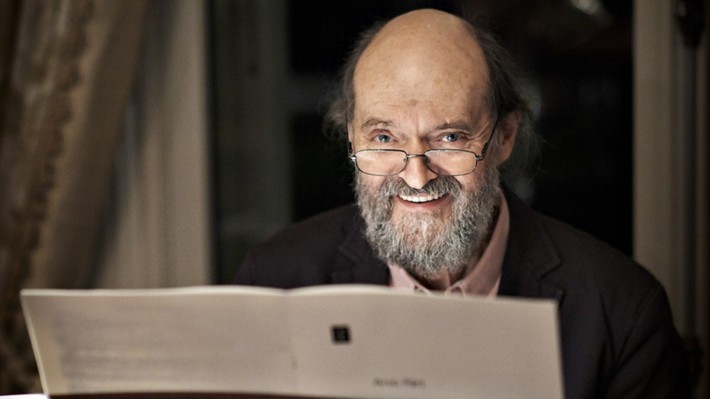
Arvo Pärt – A Complete Biography
Introduction
Arvo Pärt is one of the most influential and recognizable voices in contemporary classical music. His breakthrough development of the “tintinnabuli” technique in the 1970s reshaped the landscape of modern sacred minimalism and established him as a central figure in spiritual composition. Celebrated for his austere textures, profound quietude, and spiritual depth, Pärt’s music has attracted listeners far beyond the traditional classical music audience. Across decades of creative evolution, political upheaval, and spiritual transformation, he has remained committed to a musical language rooted in introspection, simplicity, and faith. Today he stands as a seminal figure in late-20th- and early-21st-century musical modernism.

Childhood
Arvo Pärt was born on September 11, 1935, in Paide, Estonia, and spent most of his childhood in the nearby town of Rakvere. His early years were shaped by political turbulence: Estonia was annexed by the Soviet Union, occupied by Nazi Germany, and re-annexed by the Soviets. These dramatic events influenced the cultural and intellectual environment in which he grew up.
Pärt’s exposure to music began in a modest environment. His family did not possess formal musical training, yet he showed an early intuitive sensitivity to sound. As a child, he experimented with the piano, household instruments, and makeshift noisemakers, demonstrating a natural inclination toward rhythm and melody. By the time he reached adolescence, local music teachers recognized his unusual creative potential.
Youth
In his teenage years, Pärt’s musical abilities developed rapidly. He studied at the Rakvere Music School and later at the Tallinn Music Middle School, where he began formal training in composition. His early exercises, though rudimentary, displayed a keen ear for structure and an eagerness to explore musical boundaries.
Pärt also worked briefly as a recording engineer with Estonian Radio, which exposed him to a wide range of repertoire and contemporary techniques. This experience broadened his understanding of orchestration, timbre, and musical thought. During this period, he composed juvenile works that paired conventional harmonies with experimental tendencies. Estonia’s cultural restrictions under Soviet control limited access to Western avant-garde music, yet Pärt managed to encounter and study works by composers such as Schoenberg, Webern, and Stockhausen. Their influence would deeply mark his early style.
Adulthood
Arvo Pärt entered adulthood as an emerging composer who was both admired and controversial. He studied composition formally at the Tallinn Conservatory, graduating in 1963. His earliest mature works embraced serialism, collage techniques, and experimental modernism—approaches that were often viewed with suspicion by Soviet cultural authorities. Works such as Nekrolog and Perpetuum Mobile demonstrated a fearless engagement with modernist language and were among the first serial compositions produced in Estonia.
By the late 1960s, however, Pärt experienced a profound creative crisis. Feeling constrained by the aesthetic limitations of serialism and uneasy with the spiritual emptiness he associated with it, he withdrew almost completely from composition for several years. During this time, he immersed himself in Gregorian chant, Renaissance polyphony, and early sacred repertoire. This period of study, silence, and spiritual introspection transformed him fundamentally.
In 1972, Pärt formally converted to the Russian Orthodox faith. Soon after, he emerged from his silence with a radically new musical language: tintinnabuli. This technique, named for its bell-like clarity, relied on extreme economy, triadic harmony, slow unfolding, and meditative stillness. Its clarity and austerity were in sharp contrast to the complexity of his earlier works.
However, Pärt’s spiritual orientation and sacred compositions were increasingly at odds with Soviet authorities. In 1980, facing artistic and political pressure, he emigrated with his family, first to Vienna and later to West Berlin. This relocation opened new avenues for international recognition, and prestigious ensembles and record labels soon championed his works. By the 1990s, Pärt had become a global figure in contemporary sacred minimalism.
Major Compositions
Across his career, Arvo Pärt has produced a body of work that bridges sacred tradition and contemporary expression. Among his most significant compositions are:
Fratres (1977)
A modular work written in multiple versions for various instrumentations, Fratres embodies tintinnabuli’s essence. Its repeating patterns and shifting timbral colors have made it one of Pärt’s most frequently performed pieces.
Tabula Rasa (1977)
Composed for two violins, prepared piano, and chamber orchestra, this work marked Pärt’s international breakthrough. Its atmosphere of purity, quiet tension, and transcendence signaled his full artistic rebirth.
Spiegel im Spiegel (1978)
One of Pärt’s most recognizable works, this piece for violin and piano—or several variations—is a model of introspective minimalism. Its slow unfolding and crystalline intervals have made it a staple in film soundtracks and contemporary concert programming.
Te Deum (1984–1985)
A large-scale choral and orchestral work, Te Deum reflects Pärt’s deep engagement with sacred texts. Its vast sonic architecture emphasizes stillness and awe.
Passio (1982)
Pärt’s setting of the Passion text according to St. John is among his most ambitious works. Its controlled emotional palette, chant-influenced phrasing, and ritualistic form emphasize timeless spiritual narrative over dramatic expression.
Adam’s Lament (2009)
Written after Estonia regained independence, this later composition sets a text by the Orthodox monk St. Silouan. It reflects Pärt’s mature spiritual voice and his continuing commitment to sacred themes.
These and other compositions have cemented Pärt’s reputation as a transformative figure in contemporary classical music. His works are widely recorded, performed internationally, and studied by scholars and composers.
Death
As of the latest verified information, Arvo Pärt is alive. He continues to influence global musical culture through the work of the Arvo Pärt Centre in Laulasmaa, Estonia, an institution dedicated to preserving his manuscripts and legacy, supporting research, and fostering education on his music. Should circumstances change in the future, biographical treatments will be updated accordingly to reflect the full arc of his life.
Conclusion
Arvo Pärt’s life and work demonstrate a rare synthesis of artistic courage, spiritual conviction, and compositional innovation. From his early experiments under Soviet rule to the profound silence that reshaped his creative path, and finally to the widespread acclaim of his tintinnabuli period, Pärt has remained steadfast in his pursuit of musical truth. His compositions invite listeners into spaces of contemplation and transcendence, offering an antidote to the noise of contemporary life. Today, Pärt stands not only as a leading figure in modern sacred minimalism but also as a composer whose influence reaches across genres, cultures, and generations.
Comments are closed