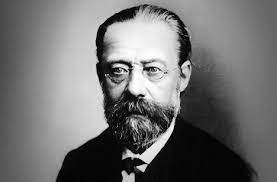
Bedřich Smetana – A Complete Biography
Introduction
Bedřich Smetana (March 2, 1824 – May 12, 1884) stands as a foundational figure in Czech musical history. Often called the “father of Czech music,” Smetana transformed Bohemian musical idioms into works of national identity. Through his operas, piano music, chamber works, and especially his symphonic cycle Má vlast (My Country), he established a distinctly Czech voice within nineteenth-century Romanticism. His life combined artistic ambition, national consciousness, personal tragedy, and physical suffering, all of which shaped a powerful and enduring musical legacy.
Childhood
Smetana was born in Leitomischl (now Litomyšl), a small town in Bohemia that was then part of the Austrian Empire. His family environment was musical: his father, an amateur violinist, introduced him to music at an early age. Smetana displayed exceptional talent as a child, learning both piano and violin and giving his first public performance while still very young. Although his family initially hoped he would pursue a more stable profession, his early exposure to music and performance made a lasting impression. The combination of provincial life and early immersion in music laid the foundation for his later sensitivity to Czech folk elements and cultural identity.
Youth
During his youth, Smetana moved between formal study, private teaching, and performance. He supported himself by working as a piano teacher and musician in aristocratic households while continuing to develop his compositional skills. These experiences allowed him to become familiar with a wide range of musical styles and repertoire. The political upheavals of 1848 played an important role in shaping his worldview, strengthening his sense of Czech national identity and cultural responsibility. As he matured, Smetana increasingly viewed music as a means of expressing the aspirations and character of his homeland.
Adulthood
Smetana’s adult life was marked by both professional achievement and personal hardship. He married and started a family, but endured profound emotional losses, including the deaths of several children. Financial instability was a persistent concern. Despite these challenges, he became an influential figure in Prague’s musical life. He founded a music school, worked as a conductor, and championed the performance of music in the Czech language at a time when German cultural dominance remained strong. His efforts met resistance from conservative circles, yet his determination helped establish the foundations of Czech national music. This period saw the full emergence of Smetana’s mature compositional voice.
Major Compositions
Smetana’s works reflect both strong national sentiment and refined musical craftsmanship.
The Bartered Bride (Prodaná nevěsta) is his most famous opera and remains one of the most successful comic operas of the nineteenth century. Combining lively dance rhythms, memorable melodies, and a clear dramatic structure, it portrays rural Czech life with warmth and humor and brought Smetana international recognition.
Má vlast (My Country) is a cycle of six symphonic poems that depict Czech landscapes, legends, and historical themes. The best-known movement, Vltava (“The Moldau”), musically traces the course of the river as it flows through the countryside and the city of Prague. The cycle as a whole represents a culmination of Smetana’s nationalist ideals and programmatic orchestral style.
String Quartet No. 1 in E minor, “From My Life,” is an autobiographical chamber work that reflects key moments of the composer’s personal and artistic journey. One movement famously alludes to the high-pitched ringing that accompanied his growing deafness, making the quartet a deeply personal statement.
In addition to these major works, Smetana composed other operas, orchestral pieces, piano works, and songs. Across all genres, his music is characterized by melodic clarity, rhythmic vitality, and a strong sense of narrative.
Illness and the Last Period of Life
In the 1870s Smetana’s health declined significantly. He began to lose his hearing, eventually becoming largely deaf. Despite this impairment, he continued to compose, demonstrating remarkable resilience and determination. Over time, his physical and mental condition worsened, leading to increasing isolation and difficulty functioning in daily life. His final years were marked by severe illness and mental deterioration, and he spent the last part of his life under medical care.
Death
Bedřich Smetana died in Prague on May 12, 1884, at the age of sixty. Although his final years were tragic, his death marked the beginning of a period in which his importance to Czech culture became even more widely recognized. His music came to be regarded as a cornerstone of national identity, and his works were embraced as symbols of Czech artistic achievement.
Conclusion
Bedřich Smetana’s legacy rests on his ability to transform national feeling into enduring musical art. By integrating Czech themes, language, and folk influences into established Romantic forms, he created a body of work that was both culturally specific and artistically universal. His operas and symphonic poems continue to be performed worldwide, while Má vlast remains a powerful emblem of Czech history and landscape. Despite personal suffering and illness, Smetana’s commitment to his artistic vision never wavered. His life and music together secure his place as one of the most significant composers of the nineteenth century and as a defining voice of Czech musical nationalism.
Comments are closed