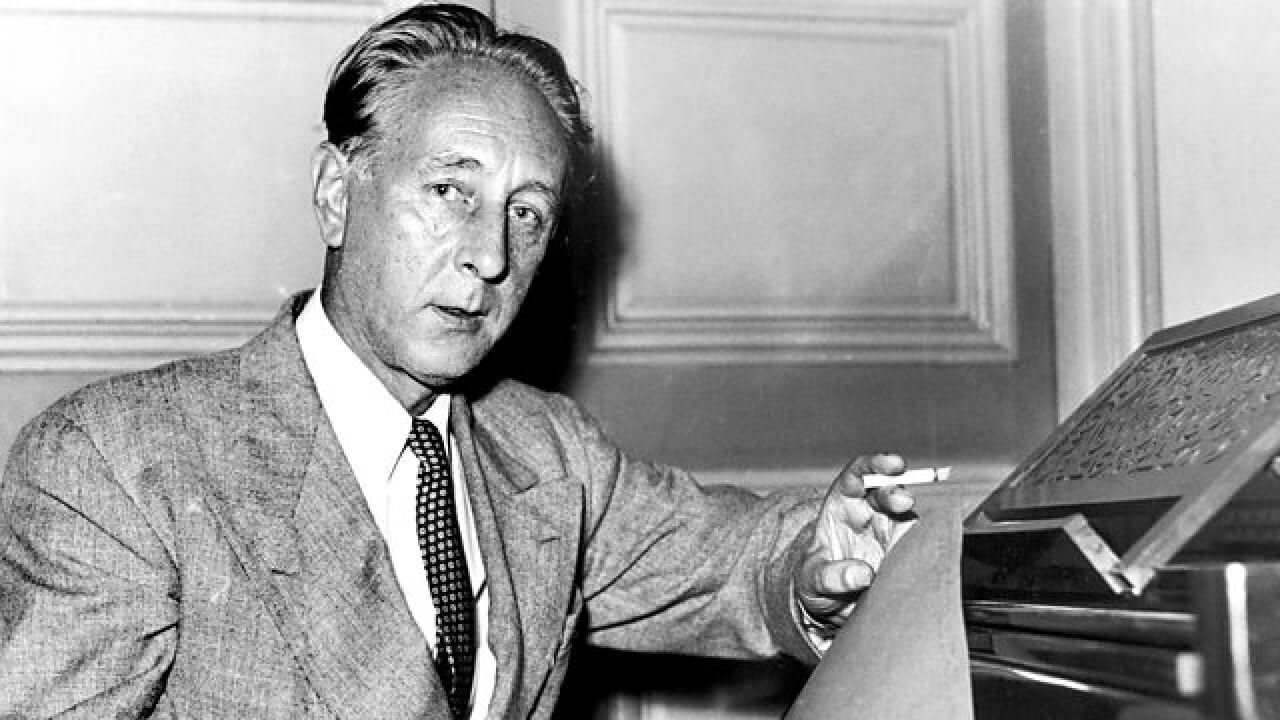
Bohuslav Martinů – A Complete Biography
Introduction
Bohuslav Jan Martinů (December 8, 1890 – August 28, 1959) was a prolific Czech composer whose wide-ranging output and distinctive voice placed him among the most important European composers of the twentieth century. He wrote in many genres—symphonies, operas, ballets, concertos, chamber music, choral works and solo pieces—and his music blends Czech folk influence with French modernism, neoclassical clarity, rhythmic vitality and occasional jazz inflections. Martinů’s life was shaped by migration, political upheaval, and a restless creative drive that produced nearly four hundred works across four decades.
Childhood
Martinů was born in the small Bohemian market town of Polička into a modest family. His father worked as a shoemaker and town constable and also served as sexton of the local church, which led to the unusual circumstance that the Martinů family lived in quarters within the church tower. From an early age Bohuslav showed musical talent: he took violin lessons as a child and gained reputation locally for his playing. His upbringing in a tight-knit provincial environment—surrounded by church music, local song and seasonal rituals—left a lasting imprint on his melodic sense and on the frequent presence of folkloric and liturgical motifs in his music.
Youth
Supported by townspeople who recognized his promise, Martinů moved to Prague in his mid-teens to pursue formal musical training. He enrolled at the Prague Conservatory, initially as a violin student; his conservatory years were turbulent. Eager to explore and teach himself much of the repertoire he admired, he chafed at the institution’s rigid discipline and was dismissed from the violin program, later transferring to the organ/composition class before again leaving the school. During this period he began composing seriously and returned periodically to Polička, where he taught, played and continued to write. After several years he secured the patronage or encouragement of established Czech musicians—most notably Josef Suk, who tutored and supported him—and Martinů’s early works began to attract attention in Prague. By the early 1920s he had composed orchestral poems, ballets and chamber works that demonstrated both lyricism and an appetite for new textures.
Adulthood
In 1923 Martinů moved to Paris on a modest scholarship—a watershed moment in his artistic development. In Paris he encountered the French avant-garde: neoclassicism, impressionism and the rhythmic procedures of Stravinsky and other contemporary figures. He studied informally with Albert Roussel and absorbed a cosmopolitan mix of influences: Prague-trained craft, Czech melodic roots, French clarity, and the occasional rhythmic and harmonic gestures drawn from jazz and popular music. The 1920s and 1930s were highly productive—he wrote ballets, chamber music and orchestral pieces that established his reputation in Europe.
The outbreak of World War II and the German occupation of Czechoslovakia forced Martinů to leave the Continent. He and his wife settled in the United States in 1941. Life in America was both opportunity and strain: Martinů found patronage and institutional support, taught at American schools and was embraced by some performers and critics, yet he longed for Europe and worried about his homeland’s fate. The mid-1940s brought some of his most important orchestral and large-scale works—many pieces that channelled grief over wartime events and the suffering of Czechoslovakia. He accepted academic posts and residencies and spent time composing in relative seclusion; the years in America include a concentrated burst of symphonic, concerto and chamber music output.
In 1953 Martinů left the United States and returned to Europe, living in France (Nice) and later Italy for a period as composer-in-residence, and finally settling in Switzerland. His late works show a loosened formal approach and a search for expressive breadth: oratorios, operas, and orchestral cycles that often look back to Czech modes of expression while remaining forward-looking in texture and structure. Throughout his adult life he was known for an almost compulsive need to compose—an extraordinary productivity combined with self-discipline.
Major Compositions
Martinů’s catalogue is vast and varied; several works stand out for their scale, imaginative force and continuing presence in the repertoire.
- Symphonies: He wrote six numbered symphonies (1942–1953) that range from the dramatic and programmatic to more purely abstract musical argument. These symphonies contain heightened emotional density and often reflect wartime displacement and personal reflection.
- Concertos and Concertante Works: Martinů composed many concertos—violin, cello, piano, oboe and unusual solo combinations. His Double Concerto for Two String Orchestras and several violin concertos are notable for their lyricism, driving rhythms and inventive solo writing.
- Ballets and Stage Works: In the 1920s he produced witty, rhythmically energetic ballets—La Revue de Cuisine (The Kitchen Revue) among them—that reveal his facility with dramaturgy and modern theatrical idioms. He also wrote operas with large-scale dramatic ambition; The Greek Passion (unfinished in conception during his lifetime, completed posthumously in various versions) remains one of his most ambitious stage works.
- Choral and Vocal Works: The oratorio The Epic of Gilgamesh and several sacred or secular cantatas show his command of large forces and his interest in mythic and spiritual narratives. His vocal writing often juxtaposes Czech folk-inflected melody with modern harmonic colors.
- Chamber and Solo Music: Martinů produced numerous string quartets, sonatas, piano pieces and chamber forms that are models of concise expression, rhythmic imagination and contrapuntal ingenuity. Works such as the string quartets and piano sonatas reveal a composer equally at home in intimate genres.
Across these major works one finds characteristic traits: rhythmic propulsion, clarity of texture, frequent use of folk-derived melodies, a prominent role for the piano or percussive keyboard sonorities within orchestral textures, and an ability to marry immediacy of feeling with formal craft.
Death
Martinů’s health declined in the late 1950s. He suffered from a brain tumour and other complications; he died in Liestal, Switzerland, on August 28, 1959. His death marked the close of a career that had traversed many geographies and political eras—an artist who had been shaped by the cultural life of his native Bohemia, the modernist circles of Paris, the wartime exile and creative refuge of America, and a final return to Europe. At the time of his death he left behind an extensive corpus that was only beginning to be reassessed and fully appreciated by performers and scholars.
Conclusion
Bohuslav Martinů remains an essential figure of twentieth-century music: a composer whose eclectic influences were fused by a protean imagination into a singular voice. His work bridges national tradition and international modernism, and his voluminous output rewards repeated listening and study. Though his life was interrupted by exile and political rupture, Martinů responded with music that is often resilient, lyrical and formally resourceful—music that continues to move audiences and challenge performers. His legacy is sustained today by critical editions, recordings, festivals and renewed scholarly attention that seek to place him within the central narratives of modern classical music.
Comments are closed