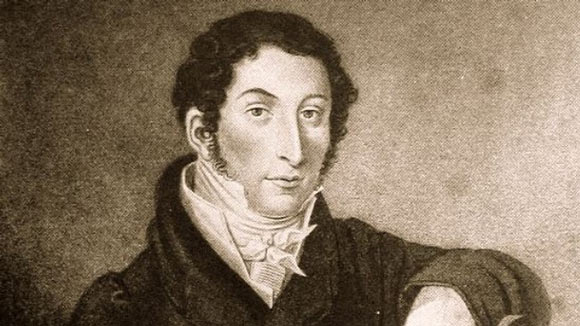
Carl Maria von Weber – A Complete Biography
Introduction
Carl Maria von Weber (1786–1826) stands among the pivotal figures of early Romantic music in Germany. A composer, conductor, pianist, and opera director, Weber helped define a distinctively German operatic voice and expanded orchestral color and national romantic expression. His operas—most notably Der Freischütz, Euryanthe, and Oberon—and his instrumental writing (including works for clarinet and his celebrated overtures) mark a transition from Classical forms toward a bolder, more atmospheric Romantic idiom. Weber’s career was marked by frequent travel, recurring health problems, and intense professional energy: he was as much an organizer and advocate for the stage as he was a creative composer.
Childhood
Carl Maria Friedrich Ernst von Weber was born in Eutin, in the duchy of Oldenburg (then part of Holstein), on November 18, 1786. He was born into a family with theatrical and musical connections: his father, Franz Anton von Weber, was an amateur violinist and army officer; his mother, Genovefa Weber, had experience on the stage. The family’s artistic background provided young Carl with early exposure to music and theater, and he showed precocious musical talent.
From his earliest years Weber’s education and musical training were irregular, shaped by his family’s financial precarity and frequent moves. He received early lessons from local teachers and family members, and by age ten was already composing and performing. His childhood was also shadowed by loss: his mother died while he was still young, and other family health crises left a mark. Despite unsettled domestic circumstances, Weber’s aptitude for composition and his affinity for dramatic music became apparent early, and his formative years laid the groundwork for the theatrical sensibility that would define his mature works.
Youth
Weber’s adolescence and early training were itinerant but formative. He studied with a succession of teachers in different German towns—receiving instruction in keyboard, composition, and orchestration—that exposed him to a range of musical traditions. Notably, in his youth he studied with the oboist Johann Peter Heuschkel and later with local teachers who supervised his earliest stage works. A brief period in Salzburg put him in contact with the legacy of the Haydn tradition; he also encountered Vienna’s musical circles and met influential figures there, though the hoped-for extended apprenticeship with major masters did not fully materialize.
During his late teens and early twenties Weber wrote a steady stream of instrumental music, songs, chamber works, and small stage pieces. He gained practical experience as a performer and conductor, which taught him the realities of theatrical production and orchestral leadership. These years consolidated his skill as an orchestrator and developed his interest in German-language theater and folk-inflected material—two elements that would become central to his operatic achievements.
Adulthood
As an adult Weber combined composing with an active professional life as conductor, theater director, and musical organizer. He held appointments in a number of German cities, including significant work in Prague and Dresden, where he refined his reputation as an energetic stage manager and as a composer attuned to dramatic pacing and coloristic orchestration. His conducting posts required him to shape repertoire, train singers, and navigate the practical and financial pressures of operatic life; those responsibilities influenced his compositional choices and his sense of what a national German opera might be.
Weber married Caroline Brand in 1817; their relationship was personally important but did not insulate him from financial stress or health problems. He cultivated friendships with other musicians and intellectuals, and he wrote essays and reviews as well as music, demonstrating a lively engagement with broader cultural debates about music and theater. Throughout the 1810s and into the 1820s he continued to produce chamber music, piano works (including salon pieces like the concert waltz Invitation to the Dance), and orchestral showpieces—yet it was his sustained work for the operatic stage that most directly shaped his legacy.
Major Compositions
Weber’s output spans vocal, stage, and instrumental music; several works stand out for their influence and longevity.
- Der Freischütz (premiered 1821): Weber’s most famous opera, Der Freischütz (The Marksman) fused German folk elements, supernatural atmosphere, and stark dramatic contrasts into a work that became emblematic of Romantic German opera. The score’s evocative orchestration—especially in the Wolf’s Glen scene—created a new model for integrating music and dramatic atmosphere. The opera’s premiere established Weber as a central figure in German musical life and set a template for later composers who wished to create a national operatic idiom.
- Euryanthe (1823): A larger-scale lyric drama in which Weber sought to unify music and stagecraft in more ambitious ways. Though its libretto has often been criticized for dramatic weaknesses, the music demonstrates Weber’s advanced sense of orchestral color and his interest in extended musical forms within an operatic context.
- Oberon (1826): Composed for an English-language production and premiered in London, Oberon synthesizes fairy-tale elements, chivalric plotlines, and Weber’s most refined orchestral writing. The overture and various set pieces from Oberon became concert favorites. Weber traveled to London to oversee the production, exerting himself greatly in the process.
- Instrumental works and concert pieces: Weber’s catalog includes overtures, symphonies, chamber music, piano works, and especially music for the clarinet—an instrument for which he wrote significant concertante pieces that remain standard repertoire. His overtures (including those to Der Freischütz and Oberon) display clarity of form, memorable thematic material, and imaginative orchestral color. The piano piece Invitation to the Dance stands as one of the early “concert waltzes” intended primarily for listening rather than for dancing; Hector Berlioz later orchestrated it, and it achieved a secondary career in orchestral guise.
Across these works Weber’s skill in orchestration, his ear for theatrical timing, and his interest in folkloric and supernatural subject matter combine to produce music that feels both immediately dramatic and emblematic of the Romantic movement’s goals.
Death
Weber’s final years were strenuous. The commission to compose Oberon for London required him to travel and to work under pressure. He took the journey to London in 1826 to supervise rehearsals and to conduct the premiere; though the premiere was a public success, the exertion took a severe toll on his already fragile health. Already subject to recurring illness for some years, Weber’s condition worsened. He died in London on June 5, 1826, at the age of thirty-nine. His death cut short a career that had already had a large impact on German opera and orchestral writing; posthumous revivals and the influence of his overtures and operatic idioms extended his musical presence well into later Romantic eras.
Conclusion
Carl Maria von Weber’s contribution to Western music is best measured not only by individual masterpieces but by the role he played in shaping an operatic and orchestral language that others—most notably later German Romantics—would inherit and transform. He helped establish German Romantic opera as a viable, culturally specific alternative to Italian and French traditions, and he advanced orchestral color and structural imagination within concert music. Though his life was relatively short and plagued by practical difficulties—money, travel, health—his music projects an enduring sense of narrative drama, orchestral ingenuity, and national character. Today Weber is remembered principally as the author of Der Freischütz and as an imaginative orchestrator whose theatrical instincts helped set the stage for the later developments of 19th-century music.
Comments are closed