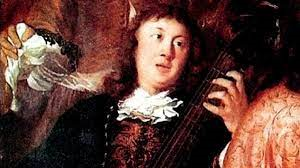
Dietrich Buxtehude – A Complete Biography
Introduction
Dietrich Buxtehude (also spelled Dieterich; c. 1637–May 9, 1707) was one of the most important figures of North German Baroque music. Celebrated as an organist, composer, and musical organizer, he played a decisive role in shaping the development of organ music and sacred vocal composition in the late seventeenth century. His influence extended far beyond his lifetime, profoundly affecting later composers, most notably Johann Sebastian Bach. Buxtehude’s legacy rests on a substantial body of organ works, sacred cantatas, instrumental music, and his innovative leadership of public church concerts that elevated the cultural life of northern Europe.
Childhood
The early years of Dietrich Buxtehude are not fully documented, and some details of his birthplace and nationality remain uncertain. He was born around 1637, most likely in Oldesloe in the region of Holstein, which at the time belonged to the Danish crown. He grew up in a musically active household: his father, Hans Buxtehude, was an organist who held positions in various towns along the Danish-German border. It is generally accepted that Dietrich received his earliest musical training from his father, learning organ performance, basic composition, and church music practices within a professional environment. This early immersion laid the foundation for his later mastery of keyboard and sacred music.
Youth
During his youth, Buxtehude followed the customary path of a professional church musician. He served as an organist in several towns, including Helsingør (Elsinore), where his father had previously worked. These early appointments allowed him to refine his technical skills, deepen his knowledge of liturgical music, and gain practical experience in church administration. As he matured, his reputation as a gifted organist and composer steadily grew. Improvisation, counterpoint, and chorale-based composition were central to his musical development, preparing him for more prominent roles in the ecclesiastical and civic musical life of northern Europe.
Adulthood
The defining period of Buxtehude’s career began with his appointment as organist at St. Mary’s Church (Marienkirche) in Lübeck, one of the most important musical posts in northern Germany. In this role, he assumed responsibility not only for organ performance but also for overseeing church music and organizing large-scale musical events. Buxtehude transformed Lübeck into a major musical center by expanding the Abendmusiken, a series of public concerts held in the church outside regular liturgical services. These performances featured elaborate vocal and instrumental works and attracted audiences and musicians from across Europe.
Buxtehude was also an influential teacher. His position in Lübeck made him a magnet for aspiring musicians, and his home became an informal center of musical instruction. Among those who traveled long distances to hear him play and learn from him were some of the most significant composers of the next generation. His professional standing was such that the Lübeck post carried a traditional requirement: any successor was expected to marry the outgoing organist’s daughter, a condition that ultimately prevented several notable candidates from assuming the position.
Major Compositions
Buxtehude’s compositional output is both extensive and stylistically influential. His organ works form the core of his reputation and include free-form praeludia, toccatas, fugues, chorale preludes, and large-scale variation forms. These pieces combine virtuosic keyboard writing with complex counterpoint and improvisatory freedom, epitomizing the North German organ tradition.
His sacred vocal music includes a large number of cantatas written for church services and special occasions. Among these works, the cantata cycle Membra Jesu Nostri stands out as a masterpiece of devotional expression, notable for its intimate scoring, emotional depth, and refined text setting. Buxtehude also composed instrumental chamber music for strings and continuo, demonstrating a strong sense of structure and expressive contrast. Although some of his works have been lost, the surviving compositions clearly show his importance as a bridge between earlier seventeenth-century styles and the mature Baroque language of the early eighteenth century.
Death
Dietrich Buxtehude died in Lübeck on May 9, 1707, after more than three decades of service at St. Mary’s Church. His death marked the end of a career that had left a lasting imprint on the musical life of northern Europe. By the time of his passing, he was widely respected as one of the leading organists and composers of his era. His music continued to circulate in manuscript form, influencing students and later composers well into the eighteenth century.
Conclusion
Dietrich Buxtehude occupies a central place in the history of Baroque music. His contributions to organ literature shaped the technical and expressive possibilities of the instrument, while his sacred vocal works helped establish models that would later be expanded by composers such as Johann Sebastian Bach. Beyond his compositions, his role as a teacher and organizer of public concerts demonstrated a forward-looking approach to musical life that blurred the boundaries between church, civic culture, and artistic innovation. Today, Buxtehude is recognized not merely as a precursor to greater figures but as a master composer in his own right, whose music continues to be performed, studied, and admired for its depth, imagination, and lasting influence.
Comments are closed