Introduction
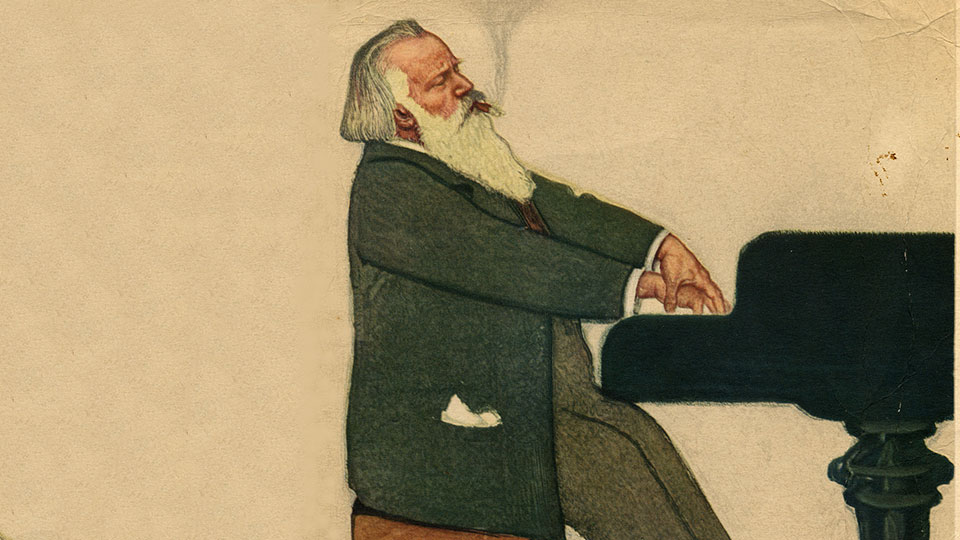
Johannes Brahms stands among the greatest composers in the history of Western classical music. A master of the Romantic era, he successfully combined deep emotional expression with the formal discipline of the Classical tradition. His music reflects a unique balance between innovation and respect for the past, earning him a place alongside composers such as Johann Sebastian Bach, Ludwig van Beethoven, and Wolfgang Amadeus Mozart.
Throughout his life, Brahms composed symphonies, concertos, chamber music, piano works, choral masterpieces, and hundreds of songs. His dedication to artistic perfection, combined with his remarkable technical skill as a pianist and composer, helped shape the future of classical music. Although he lived during a period of rapid musical change, Brahms remained committed to the structural principles established by earlier masters while creating works that were unmistakably his own.
Childhood
Johannes Brahms was born on May 7, 1833, in Hamburg, Germany. He was the second of three children born to Johann Jakob Brahms and Johanna Henrika Christiane Nissen. His father was a professional musician who played several instruments, including the double bass and horn, while his mother worked as a seamstress.
The Brahms family lived modestly, and financial difficulties were a constant reality. Despite these challenges, music played a central role in the household. Recognizing his son’s talent at an early age, Johann Jakob introduced Johannes to music and arranged formal piano lessons.
Brahms demonstrated exceptional musical abilities as a child. By the age of seven, he was studying piano seriously under Friedrich Wilhelm Cossel, who later recommended him to the respected teacher Eduard Marxsen. Under Marxsen’s guidance, Brahms received a thorough education in composition, counterpoint, harmony, and the works of the great Classical masters.
As a boy, Brahms was also an avid reader. He developed a lifelong love of literature, poetry, and philosophy, interests that would later influence many of his vocal and choral compositions.
By the age of ten, he was already performing publicly as a pianist. His remarkable talent attracted attention, and some believed he could become a child prodigy comparable to Mozart. However, his teachers preferred that he receive a solid musical education rather than pursue fame too early.
Youth
During his teenage years, Brahms helped support his family by performing in cafés, taverns, dance halls, and theaters around Hamburg. These experiences exposed him to a wide range of musical styles and audiences. Although the work was often difficult, it strengthened his skills as a pianist and broadened his musical understanding.
In the early 1850s, Brahms met the Hungarian violinist Eduard Reményi, with whom he toured as an accompanist. Through Reményi, Brahms encountered Hungarian folk music, which would later inspire his famous Hungarian Dances.
A pivotal moment in Brahms’s life occurred in 1853 when he met the celebrated violinist Joseph Joachim. Joachim immediately recognized Brahms’s extraordinary talent and introduced him to composer Robert Schumann and pianist Clara Schumann.
Robert Schumann was deeply impressed by the young musician. In a famous article, he proclaimed Brahms a musical genius destined for greatness. This public endorsement instantly brought Brahms to the attention of the European musical community.
The Schumanns became some of the most important people in Brahms’s life. He developed a particularly close relationship with Clara Schumann, one of the greatest pianists of the nineteenth century. Their friendship would endure for more than four decades and profoundly influence both their lives.
During this period, Brahms composed piano sonatas, songs, chamber works, and his first significant orchestral pieces. At the same time, he developed a reputation as a perfectionist, frequently revising or destroying compositions that failed to meet his demanding standards.
Adulthood
In the 1860s, Brahms gradually established himself as one of Europe’s leading composers. He moved to Vienna, a city that would become his permanent home and the center of his professional life.
Vienna provided an ideal environment for Brahms. Rich in musical tradition, it had once been home to Haydn, Mozart, Beethoven, and Schubert. Brahms admired these composers deeply and sought to continue their legacy.
His international reputation grew significantly after the premiere of A German Requiem in 1868. Unlike traditional requiem masses, the work used German biblical texts selected by Brahms himself. The composition achieved tremendous success and established him as a major artistic figure.
Despite his growing fame, Brahms remained private and reserved. He never married, although he experienced several romantic relationships and maintained a lifelong affection for Clara Schumann. Many scholars believe that his dedication to music and his independent nature contributed to his decision to remain a bachelor.
During the following decades, Brahms traveled extensively throughout Europe as a pianist, conductor, and composer. His works were performed in major cities, and he became one of the most respected musicians of his era.
Brahms also supported younger composers, including Antonín Dvořák. Recognizing Dvořák’s talent, he helped promote the Czech composer’s music and career.
Throughout his life, Brahms maintained strict artistic standards. He was known to spend years refining a composition before allowing it to be published. This commitment to excellence resulted in a relatively modest output compared to some composers, but the quality of his works remains universally admired.
Major Compositions
Johannes Brahms produced masterpieces in nearly every major musical genre except opera.
Among his most celebrated works are his four symphonies:
Symphony No. 1 in C Minor, Op. 68
Completed in 1876 after many years of work, this symphony was viewed as a worthy successor to Beethoven’s symphonic tradition.
Symphony No. 2 in D Major, Op. 73
More lyrical and pastoral than its predecessor, this work quickly became one of his most popular compositions.
Symphony No. 3 in F Major, Op. 90
Known for its emotional depth and structural elegance, the Third Symphony remains a favorite among conductors and audiences.
Symphony No. 4 in E Minor, Op. 98
Often considered his greatest symphonic achievement, the Fourth Symphony combines intellectual rigor with profound emotional power.
Other major orchestral works include:
- Piano Concerto No. 1 in D Minor
- Piano Concerto No. 2 in B-flat Major
- Violin Concerto in D Major
- Double Concerto for Violin and Cello
His choral masterpiece, A German Requiem, stands among the most important sacred works of the nineteenth century.
Brahms also excelled in chamber music. Notable examples include:
- Piano Quintet in F Minor
- Clarinet Quintet in B Minor
- String Sextets Nos. 1 and 2
- Three Piano Quartets
- Three Piano Trios
His piano music includes sonatas, variations, intermezzi, rhapsodies, and character pieces that remain central to the piano repertoire.
Additionally, Brahms composed more than 200 songs. Among the most famous is the lullaby Wiegenlied (“Brahms’s Lullaby”), one of the most recognizable melodies ever written.
His Hungarian Dances achieved enormous popularity and remain among his most frequently performed works.
Death
In the mid-1890s, Brahms’s health began to decline. Although he remained active for a time, he gradually became weaker. Physicians eventually diagnosed a serious liver illness, now generally believed to have been liver cancer.
Despite his deteriorating condition, Brahms continued to attend musical performances and maintain contact with friends and colleagues. His final public appearance occurred in March 1897, when he attended a performance of his Fourth Symphony in Vienna.
Johannes Brahms died on April 3, 1897, at the age of sixty-three. His death was mourned throughout Europe and beyond. Thousands attended his funeral in Vienna, recognizing the loss of one of the greatest composers of the nineteenth century.
He was buried in Vienna’s Central Cemetery, near the graves of other celebrated composers.
Conclusion
Johannes Brahms left behind a musical legacy of extraordinary depth, beauty, and craftsmanship. His works embody the highest ideals of the Classical tradition while embracing the emotional richness of Romanticism. Through his symphonies, concertos, chamber music, songs, and choral works, he demonstrated an unparalleled ability to unite intellectual structure with heartfelt expression.
More than a century after his death, Brahms’s music continues to occupy a central place in concert halls around the world. His compositions remain essential to the repertoire of orchestras, chamber ensembles, choirs, and solo performers. As both a guardian of tradition and a creative innovator, Johannes Brahms secured his place among the immortal giants of classical music.
Comments are closed