Mikhail Glinka – A Complete Biography
Introduction
Mikhail Ivanovich Glinka (1804–1857) is widely regarded as the founder of the Russian nationalist school in classical music—the first Russian composer to earn sustained recognition and to show how native song, history, and rhetoric could be forged into art music. His two operas, A Life for the Tsar and Ruslan and Lyudmila, became touchstones for later generations, while his orchestral fantasy Kamarinskaya famously seeded Russia’s symphonic tradition.
Childhood
Glinka was born on May 21 (June 1, New Style), 1804, in Novospasskoye, in the Smolensk Governorate of the Russian Empire. Frail and cosseted by an overprotective grandmother, he grew up hearing church bells and folk singing; later, at his uncle’s nearby estate, a private orchestra introduced him to Haydn, Mozart, and Beethoven—experiences he remembered as formative.
Youth
At 13 he left for St. Petersburg to study at the elite Chief Pedagogical Institute (1818–22) and took piano lessons—briefly even with the Irish composer-pianist John Field. After a short stint in government service, he composed romances and chamber pieces as a dilettante before deciding to strengthen his craft abroad. A three-year sojourn in Italy (1830–33) immersed him in bel canto and included lessons in Milan with Francesco Basili; a subsequent stop in Berlin brought six months of counterpoint study with the renowned theorist Siegfried Dehn. These travels crystallized his desire to “write in a Russian manner.”
Adulthood
Back in Russia, Glinka married Maria Petrovna Ivanova in 1835—an unhappy union that soon dissolved—but professionally he turned a corner with A Life for the Tsar (premiered December 9, 1836, St. Petersburg). Its success led to an appointment with the Imperial Chapel Choir in 1837; in 1838 he toured Ukraine to recruit voices. He then labored over Ruslan and Lyudmila, premiered on November 27, 1842, at the Bolshoi Kamenny Theatre. Mid-century travels to Paris and Spain yielded his “Spanish overtures,” and by the 1850s he was a revered figure whose music circulated widely across Europe.
Major Compositions
Operas. A Life for the Tsar pairs patriotic subject matter with native melodies and became the first Russian opera to secure a permanent place in the repertoire; it premiered in St. Petersburg in 1836 and long served as an emblem of imperial loyalty. Ruslan and Lyudmila, based on Pushkin, initially met a cooler reception in 1842 but later won favor—its whirlwind overture is now a concert staple. Both works showed how Russian themes and folk idioms could be integrated with European operatic technique.
Orchestral music and the “Russian symphonic school.” With Kamarinskaya (1848), an orchestral fantasy on two folk tunes, Glinka demonstrated a new way to build large forms from repetition with ever-changing orchestral “backgrounds.” Tchaikovsky later called it “the acorn from which the oak of Russian symphonic music grew,” an assessment now standard in music history.
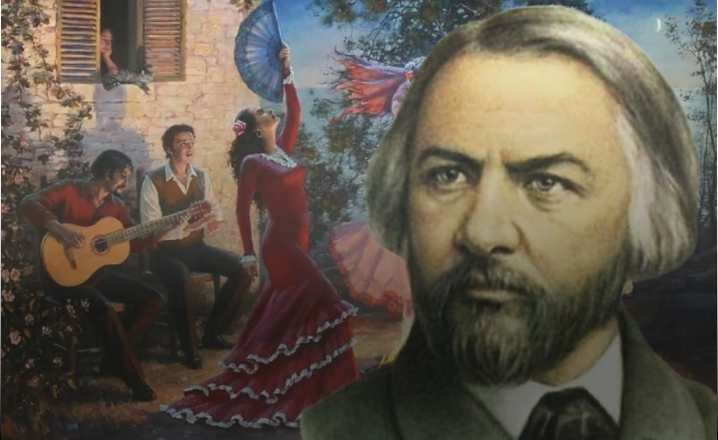
Spanish portraits. During and after his Iberian travels, Glinka wrote Jota Aragonesa (Spanish Overture No. 1, 1845) and Summer Night in Madrid (also known as A Night in Madrid, 1848/1851), vivid orchestral postcards that enjoyed enduring concert life outside Russia.
Songs and chamber music; occasional works. Glinka’s art songs (romances) were prized in his own day, and chamber pieces such as the Trio pathétique (1832) show his lyrical gifts. His Festival Polonaise (1855) was composed for the coronation festivities of Alexander II. Decades after his death, his short Patrioticheskaya pesnya (“Patriotic Song,” 1833) was adopted as Russia’s anthem from 1990 to 2000—an emblem of his lingering cultural presence.
Death
In late 1856 Glinka went to Berlin, where he fell ill and died on February 15, 1857. Initially buried there, he was soon reinterred in St. Petersburg at the Tikhvin Cemetery of the Alexander Nevsky Monastery—final resting place of many Russian artists.
Conclusion
Glinka’s output is modest in size but monumental in consequence. By wedding folk melody, national history, and European technique, he made a Russian style legible at home and abroad, shaping the aesthetic of “The Five” (Balakirev, Borodin, Mussorgsky, Cui, and Rimsky-Korsakov) and, through Kamarinskaya, pointing the way for Russia’s symphonists. In short, later giants grew in the soil he tilled.
Comments are closed