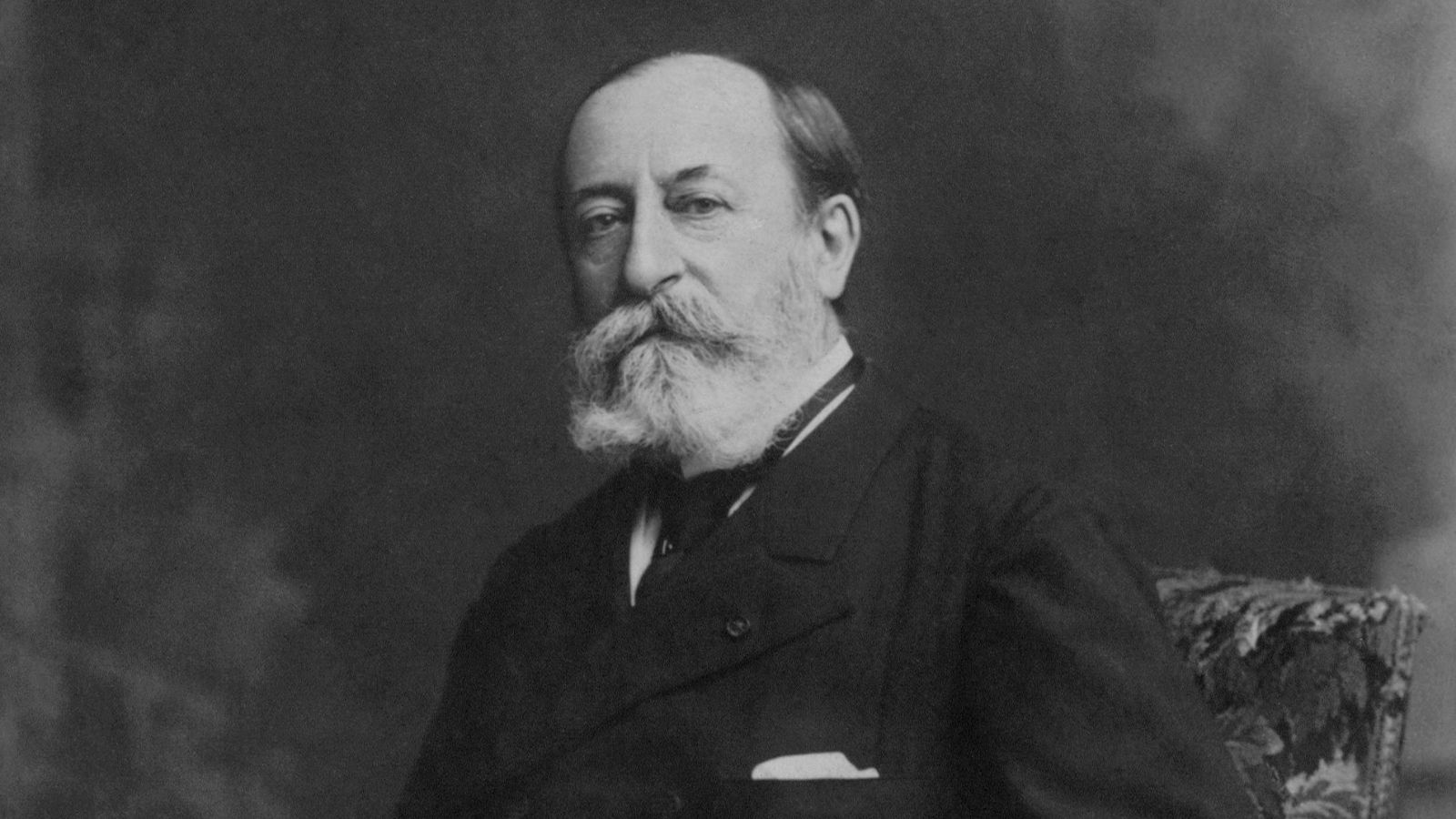
Camille Saint-Saens – A Complete Biography
Introduction
Charles-Camille Saint-Saëns (October 9, 1835 – December 16, 1921) was a French composer, pianist, organist, and conductor whose career bridged the late Romantic era and early 20th century. Celebrated for his technical mastery, elegant craftsmanship, and breadth of output, he produced symphonies, concertos, operas, chamber works, choral music, piano and organ pieces, and songs. Though admired in his lifetime for musical polish and classical balance, later generations have alternately praised and criticized him for restraint and conservatism; nonetheless, several of his works—most notably Samson et Dalila, The Carnival of the Animals, and the Third (“Organ”) Symphony—remain central to the concert repertoire. This biography traces Saint-Saëns’s life from his precocious childhood through his long professional career, surveys his principal works, and reflects on his artistic legacy.
Childhood
Camille Saint-Saëns was born in Paris into a cultured, middle-class household. His father, a civil servant and amateur musician, died when Camille was very young; his mother and an aunt then presided over his upbringing and early musical education. The boy displayed extraordinary musical gifts from infancy: he was reading music before he could read words and was composing brief pieces by age three. He was given formal lessons in piano and later in organ and composition; his facility for keyboard technique and contrapuntal thinking marked him as a prodigy.
By his early teens Saint-Saëns had already achieved public recognition. He made a concert debut while still a child and wrote substantial works in his adolescence, including an early symphony that showed maturity in form and orchestration. His training combined conservative academic grounding with exposure to contemporary currents; even as a youth he absorbed the works of older masters while showing interest in new music and ideas.
Youth
Saint-Saëns entered the Paris Conservatoire in the late 1840s, where he studied organ, piano, and composition. The Conservatoire provided rigorous counterpoint and formal training, and Saint-Saëns’s dexterity as a keyboard player and organist quickly became widely noted. During this period he began to build a reputation not only as a composer but also as a performer: as an organist he was recognized for clarity of touch and improvisatory imagination, and as a pianist he was praised for technique and stylistic range.
In his twenties Saint-Saëns accepted the post of organist at Saint-Merri and later at La Madeleine in Paris—positions that offered financial stability and regular opportunities to play and compose liturgical and concert music. He also commenced a career as a teacher and critic: he briefly taught at the École Niedermeyer, where his influence on students (including Gabriel Fauré) became an important thread in French musical life. From his youth onward Saint-Saëns combined performing, composing, arranging, and scholarly interest in earlier music; he championed the works of Baroque composers and sometimes produced editions and revivals.
Adulthood
The middle decades of Saint-Saëns’s life brought growing fame and a busy professional calendar. As a freelance musician after leaving his post at La Madeleine, he toured widely as a pianist and conductor, traveled through Europe and the Americas, and accepted honors and distinctions. His style evolved to balance classic forms and formal clarity with vivid orchestral color and occasional programmatic elements.
Saint-Saëns maintained an unusually broad output. He wrote operas (both grand and comic), orchestral works including concertos and symphonic poems, chamber music, solo piano literature, and a great many songs. He could write concise salon pieces and large-scale works with equal fluency. Prominent in his adult career was his advocacy for French music—both historical and contemporary—and his resistance to certain stylistic excesses, which led critics to label him conservative even as he continued to experiment with forms and orchestration.
He occupied a position of public esteem in French musical institutions, receiving national honors and foreign decorations. He was a keen traveler and cultural observer: late in life he undertook trips to North Africa and elsewhere that influenced a few works. Though he did not establish a school in the sense of followers who reproduced his aesthetic, he taught and influenced younger musicians—his pupil Gabriel Fauré being the most notable example.
Major compositions
Saint-Saëns’s catalogue is large and stylistically varied; several works stand out for their lasting popularity and artistic importance:
- Symphony and early orchestral works: He displayed precocity with a symphony composed in his teens; later symphonies reveal mastery of classical forms with late-Romantic color.
- Piano concertos and solo works: His piano concertos and virtuosic works for keyboard showcase a blend of technical brilliance and formal restraint. He also produced accomplished chamber music for keyboard and solo piano pieces of character.
- Violin and cello concertos: His concertos for strings combine lyricism and formal clarity and remain staples of solo repertoire.
- Organ Symphony (Symphony No. 3): Nicknamed the “Organ” Symphony for its prominent use of organ, it is among his most frequently performed large-scale works—noted for dramatic gestures, rich sonorities, and structural craftsmanship.
- Opera – Samson et Dalila: His opera Samson et Dalila achieved international success for its melodic invention, dramatic pacing, and the famous choirs and arias that have entered standard operatic repertory.
- Incidental and program pieces: Works such as Danse macabre and his symphonic poems display colorful orchestration and evocative atmospheres.
- The Carnival of the Animals: Composed as a humorous suite featuring character pieces for various instruments, this work has become one of Saint-Saëns’s most beloved and frequently performed works, prized for its wit, clarity, and memorable tunes.
- Songs and chamber music: He wrote numerous mélodies (art songs) and an extensive body of chamber works that include sonatas for various instruments, often exploring unusual instrumental combinations.
Throughout these works, listeners find a composer committed to craftsmanship: clear textures, elegant proportions, contrapuntal skill, and orchestral refinement.
Death
Saint-Saëns remained active into advanced age, continuing to compose, perform, and travel. In the closing years of his life he experienced the loss of contemporaries and the shifting musical landscape of the early 20th century; modernist currents and shifting tastes sometimes cast him as emblematic of an earlier aesthetic. Nevertheless, he kept an active schedule and retained considerable public esteem.
He died in Algiers on December 16, 1921. His passing prompted widespread obituary notices that acknowledged his long service to French music, his technical mastery, and his numerous honors. After his death his music continued to be performed and reassessed—some pieces achieving permanent popularity while others were periodically reappraised by scholars and performers.
Conclusion
Camille Saint-Saëns combined prodigious early talent with a lifetime’s disciplined craftsmanship. He was at once a public performer, a creative composer across genres, a scholar of earlier music, and a figure of institutional importance in French musical life. His legacy is twofold: a handful of iconic works that remain central to concert life, and a large, varied corpus that reveals a composer devoted to formal clarity, melodic invention, contrapuntal skill, and orchestral color. Over time critical opinion has fluctuated, but the endurance of works such as Samson et Dalila, the Organ Symphony, Danse macabre, and The Carnival of the Animals attests to Saint-Saëns’s continuing relevance and the lasting appeal of his musical gifts.
Comments are closed