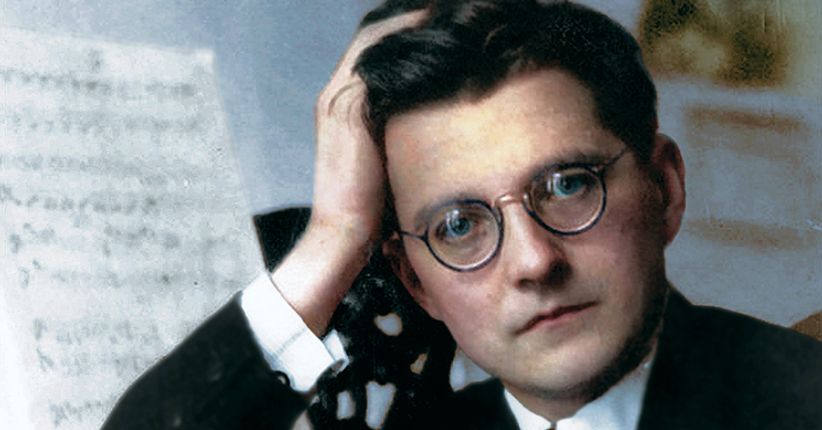
Dmitri Shostakovich – A Complete Biography
Introduction
Dmitri Dmitriyevich Shostakovich (September 25, 1906 – August 9, 1975) was one of the most influential and complex composers of the twentieth century. His body of work includes fifteen symphonies, fifteen string quartets, operas, concertos, film scores, and numerous chamber and vocal compositions. Shostakovich’s music reflects a unique synthesis of formal rigor, emotional depth, and sharp irony, shaped decisively by the political realities of life in the Soviet Union. His career was marked by cycles of public acclaim and official condemnation, and his compositions often balance outward conformity with deeply personal expression. Today, he is regarded as a central figure in modern classical music, whose works continue to provoke interpretation and debate.
Childhood
Shostakovich was born in St. Petersburg into an educated and culturally aware family. His father worked as an engineer and administrator, while his mother was a trained pianist who introduced him to music at an early age. Dmitri demonstrated exceptional musical ability almost immediately, particularly at the piano. His childhood coincided with a period of extreme political and social upheaval, including the First World War and the Russian Revolution, events that disrupted daily life but also reshaped cultural institutions. Despite these challenges, his musical education progressed rapidly, and his talent was recognized early by teachers who encouraged him to pursue formal training.
Youth
In 1919, Shostakovich entered the Petrograd Conservatory, where he studied piano and composition. He proved to be an outstanding student, known for his technical precision, sharp intellect, and distinctive musical voice. During his teenage years, he began composing works that revealed a keen sense of satire, dramatic contrast, and modern harmonic language. His graduation piece, the Symphony No. 1, premiered in 1926, was an immediate success and brought him international recognition. By his early twenties, Shostakovich was considered one of the most promising young composers in Europe, admired for his originality and command of large-scale form.
Adulthood and the Soviet Context
Shostakovich’s adult life was inseparably linked to the cultural policies of the Soviet state. In 1936, his career was abruptly endangered when one of his operas was publicly condemned by the authorities. This denunciation placed him at serious personal and professional risk and forced him to reconsider how openly experimental or provocative his music could be. From that point forward, Shostakovich adopted a cautious public stance, composing works that could be interpreted as aligning with official expectations while embedding deeper, often ambiguous meanings beneath the surface.
His Symphony No. 5 marked a turning point, restoring his official standing and becoming one of his most frequently performed works. During World War II, Shostakovich emerged as a symbol of cultural resistance, particularly through symphonic works that were widely associated with endurance and collective struggle. In the postwar decades, he continued to experience alternating periods of favor and criticism, yet remained a central figure in Soviet musical life. Alongside his public compositions, he produced intensely personal chamber music that many listeners regard as his most revealing artistic statements.
Major Compositions
Shostakovich’s compositional output is notable for its breadth and consistency across genres. His fifteen symphonies trace an artistic journey from youthful brilliance to profound introspection, often engaging with themes of conflict, irony, and resignation. The fifteen string quartets form a parallel cycle, frequently described as a musical diary that documents his inner life with exceptional candor. He also composed influential concertos for piano, violin, and cello, as well as operas, ballets, and a substantial number of film scores.
Stylistically, his music is characterized by strong rhythmic drive, sharp contrasts, recurring motifs, and an expressive range that can shift rapidly from sarcasm to lyricism. His use of musical codes, quotations, and self-references adds further layers of meaning, contributing to the enduring fascination surrounding his work.
Death
In his later years, Shostakovich suffered from severe and persistent health problems, including heart disease and neurological impairments that limited his ability to perform and compose. Despite these difficulties, he continued working, producing several late compositions marked by austerity and emotional depth. He died in Moscow on August 9, 1975, at the age of sixty-eight. He was buried with state honors, reflecting his status as one of the Soviet Union’s most prominent cultural figures.
Conclusion
Dmitri Shostakovich occupies a singular place in the history of classical music. His works reflect the contradictions of his life: public success and private anxiety, compliance and resistance, irony and sincerity. Few composers have captured the psychological and moral tensions of their time with such power and complexity. Today, Shostakovich’s music remains central to the international repertoire, valued not only for its technical mastery but also for its profound engagement with the human condition. His legacy endures as a testament to the resilience of artistic expression under pressure.
Comments are closed