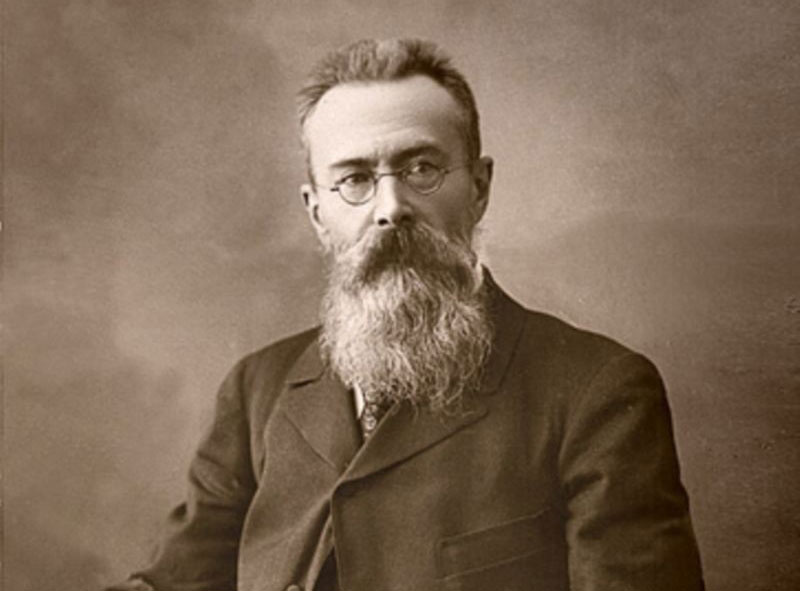
Introduction
Nikolai Andreyevich Rimsky-Korsakov was one of the most influential composers of the late nineteenth and early twentieth centuries. Renowned for his brilliant orchestration, vivid musical storytelling, and deep connection to Russian folklore, he played a central role in shaping the identity of Russian classical music. His works are celebrated for their colorful orchestral textures, exotic harmonies, and imaginative depictions of legends, fairy tales, and historical events.
Although he began his career as a naval officer with little formal musical training, Rimsky-Korsakov eventually became one of Russia’s greatest composers and teachers. His influence extended far beyond his own compositions, as he mentored a generation of musicians who would continue to define Russian music in the twentieth century. Today, he is remembered for masterpieces such as Scheherazade, Capriccio Espagnol, and The Flight of the Bumblebee, works that remain popular throughout the world.

Childhood
Nikolai Rimsky-Korsakov was born on March 18, 1844, in Tikhvin, a small town located near Saint Petersburg in the Russian Empire. He was born into a noble family with a strong tradition of military service. His father, Andrei Petrovich Rimsky-Korsakov, was a government official, while his older brother Voin enjoyed a distinguished naval career.
Music was present in the household from an early age. Young Nikolai displayed a natural aptitude for music and began taking piano lessons as a child. He quickly developed an appreciation for Russian folk songs, church music, and the works of European composers. Despite his musical interests, his family expected him to follow the family tradition and pursue a military career.
The cultural atmosphere of nineteenth-century Russia was undergoing significant changes during his childhood. Intellectuals and artists increasingly sought to establish a uniquely Russian artistic identity rather than merely imitating Western European traditions. These ideas would later become central to Rimsky-Korsakov’s artistic development.
Youth
At the age of twelve, Rimsky-Korsakov entered the Naval Cadet Corps in Saint Petersburg. The rigorous training prepared young men for service in the Imperial Russian Navy, leaving little time for musical pursuits. Nevertheless, he continued studying piano and became increasingly fascinated by composition.
During his years in Saint Petersburg, he was introduced to important musical circles. A pivotal moment occurred when he met composer Mily Balakirev, the leader of a group of nationalist composers later known as “The Five” or “The Mighty Handful.” The group also included César Cui, Modest Mussorgsky, and Alexander Borodin.
Balakirev recognized Rimsky-Korsakov’s potential and encouraged him to compose. Under his guidance, the young naval officer began work on his First Symphony, an ambitious project for someone with limited formal training. The symphony was completed while he was still serving in the navy and became one of the earliest significant Russian symphonies.
Between 1862 and 1865, Rimsky-Korsakov embarked on a naval voyage around the world. The journey exposed him to different cultures, landscapes, and musical traditions. These experiences broadened his artistic imagination and later contributed to the exotic themes that appeared in many of his compositions.
Adulthood
Upon returning from naval service, Rimsky-Korsakov devoted increasing attention to music. In 1871, despite his lack of formal academic training, he was appointed Professor of Composition and Orchestration at the Saint Petersburg Conservatory. Recognizing gaps in his own education, he undertook a rigorous self-study program, mastering harmony, counterpoint, and orchestration.
This period marked a transformation in his career. He gradually evolved from a largely self-taught composer into a highly disciplined musician with exceptional technical skill. His teaching career became as important as his compositional work. Among his students were future giants of Russian music, including Alexander Glazunov, Anatoly Lyadov, and Igor Stravinsky.
Rimsky-Korsakov became deeply involved in the preservation and development of Russian music. He edited and completed works left unfinished by his friend Modest Mussorgsky and helped promote the music of fellow Russian composers. His dedication to Russian musical culture made him one of the leading artistic figures of his generation.
During the late nineteenth century, he composed many of his most famous orchestral and operatic works. He drew inspiration from Russian folklore, fairy tales, literature, and Eastern legends. His operas often featured magical settings and richly imagined characters, while his orchestral works demonstrated unparalleled skill in creating vivid musical colors.
Political events also influenced his life. During the Russian Revolution of 1905, he publicly supported protesting students and faculty members at the conservatory. His stance led to temporary dismissal from his position, but widespread support from the musical community eventually resulted in his reinstatement.
By the beginning of the twentieth century, Rimsky-Korsakov was internationally recognized as one of Russia’s foremost composers. His music was performed across Europe and beyond, securing his reputation as a master orchestrator and musical storyteller.
Major Compositions
Rimsky-Korsakov produced an extensive body of work that includes operas, orchestral music, chamber compositions, and educational writings. His compositions are admired for their imaginative themes and brilliant orchestration.
Scheherazade (1888)
Perhaps his most famous work, Scheherazade is a symphonic suite inspired by stories from One Thousand and One Nights. The music depicts adventures, voyages, and exotic landscapes through colorful orchestral writing. The solo violin represents the storyteller Scheherazade, whose voice weaves throughout the composition.
Capriccio Espagnol (1887)
Inspired by Spanish folk melodies, Capriccio Espagnol showcases Rimsky-Korsakov’s mastery of orchestral color. The work is filled with energetic rhythms, vibrant instrumental effects, and dazzling virtuosity.
Russian Easter Festival Overture (1888)
This orchestral work draws upon traditional Russian Orthodox liturgical music. It combines religious themes with festive orchestral brilliance, creating a powerful celebration of Russian culture and spirituality.
The Flight of the Bumblebee (1899–1900)
Originally composed as an orchestral interlude for the opera The Tale of Tsar Saltan, The Flight of the Bumblebee became one of the most recognizable pieces in classical music. Its rapid, swirling notes vividly depict the buzzing movement of a bee.
Sadko (1896)
Based on a Russian folk legend, the opera Sadko reflects Rimsky-Korsakov’s fascination with mythology and folklore. The work includes memorable scenes depicting the underwater kingdom of the Sea King.
The Golden Cockerel (1907)
One of his final operas, The Golden Cockerel is a satirical work that critiques political authority and human folly. Although controversial during its time, it is now considered one of his greatest achievements.
Other Notable Works
Additional significant compositions include The Snow Maiden, The Invisible City of Kitezh, Antar, May Night, Christmas Eve, and Mlada. Together, these works illustrate the breadth of his imagination and his commitment to Russian cultural themes.
Death
In his later years, Rimsky-Korsakov suffered from recurring health problems, particularly heart disease. Despite declining health, he continued composing and teaching while remaining active in Russian musical life.
He spent much of his final period at his estate in Lyubensk, where he worked on revisions of earlier compositions and completed new projects. His final years were marked by both artistic accomplishment and growing concern about political tensions within Russia.
Nikolai Rimsky-Korsakov died on June 21, 1908, at the age of sixty-four. He passed away at his country estate near Luga in the Russian Empire. His death was widely mourned throughout Russia and the international musical community.
He was buried in Saint Petersburg, where many of Russia’s most distinguished cultural figures were laid to rest. His passing marked the end of an era in Russian music, but his influence continued through his students and the enduring popularity of his works.
Conclusion
Nikolai Rimsky-Korsakov occupies a unique place in the history of classical music. From his beginnings as a naval officer to his emergence as one of Russia’s greatest composers, his life was marked by extraordinary artistic growth and achievement. His mastery of orchestration transformed the possibilities of symphonic music, while his operas helped define a distinctly Russian musical tradition.
As a composer, teacher, editor, and cultural advocate, he shaped the future of Russian music more profoundly than almost any of his contemporaries. His influence can be heard in the works of later composers, including Igor Stravinsky, Sergei Prokofiev, and Dmitri Shostakovich.
More than a century after his death, Rimsky-Korsakov’s music continues to captivate audiences with its beauty, imagination, and expressive power. His legacy remains a testament to the enduring richness of Russian musical culture and to the creative genius of one of its greatest masters.
Comments are closed